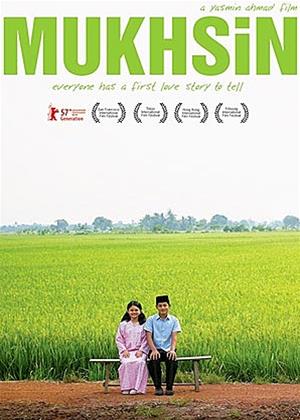
Mukhsin (2006)
- General info
- Available formats
- Synopsis:
- Mukhsin (Mohd Syafie Naswip), a 12-year-old boy, develops a friendship with Orked (Sharifah Aryana), a 10-year-old girl, and quickly develops a crush on her. He becomes tormented by his love for her but their relationship remains a platonic one.
- Actors:
- Mohd Syafie Naswip, Sharifah Aryana, Salehuddin Abu Bakar, Yasmin Ahmad, Sharifah Aleya, Sharifah Amani, Ahmad Hashim, Yuhang Ho, Seng Tat Liew, Amira Nasuha, Choo Seong Ng, Adibah Noor, Norkhiriah, Rozie Rashid, Inom Yon
- Directors:
- Yasmin Ahmad
- Producers:
- Ahmad Puad Onah
- Writers:
- Yasmin Ahmad
- Aka:
- Muksin
- Genres:
- Children & Family, Comedy, Drama
- Countries:
- Malaysia
More like Mukhsin

Found in these customers lists
Reviews (1) of Mukhsin
A Boy, A Girl, A Goodbye - Mukhsin review by griggs
Mukhsin is the kind of coming-of-age film that sneaks up on you. It floats through sun-drenched Malaysian afternoons—kids on creaky bikes, parents teasing in the kitchen, cultural norms quietly bent while a neighbour gossips from across the road. The pace is cosy—sometimes too cosy—but every digression plants a seed that later blooms.
Yasmin Ahmad’s camera finds poetry in the ordinary: shared jokes, bursts of laughter, and moments that slip by unnoticed in louder films. Her touch is light, but the themes run deep—gender, conformity, tenderness, and what it means to grow up different. The tone has none of Hollywood’s manic urgency; there’s stillness here, and space to breathe.
What makes the film sing is the friendship at its heart. Orked and Mukhsin aren’t sweethearts—they’re kids, tiptoeing along the fuzzy edge between mateship and something more. They swap jokes, trade secrets, and steal glances when adults aren’t looking. He’s allowed softness. She’s allowed cheek. Together, they sketch a kind of emotional blueprint—less about romance, more about trust.
Orked’s family are outsiders, emotionally open and deeply connected. You’d swear they wandered in off the street, fully formed. That warmth makes Mukhsin’s alienation cut deeper. He’s the new boy in a place that doesn’t know how to handle him—and Yasmin captures that with heartbreaking clarity.
Ahmad explores the gap between public performance and private truth. In this world, women defer in public but rule in private. Orked’s household flips the script: her parents flirt, argue, and love each other out loud. The mother isn’t submissive; the father isn’t aloof. There’s real equality—radical, not because it’s shouted, but because it’s shown.
The beauty of Mukhsin lies in its contrasts. It feels gentle, safe—but life creeps in. Childhood isn’t a bubble, and kindness isn’t armour. Even in the sunniest villages, shame and compromise live just under the surface. Ahmad lets that tension simmer, then gently, devastatingly, breaks the spell.
The final reveal—pulling back to show the crew—isn’t a gimmick. It’s a gesture of love. She’s saying: this is a memory, a truth wrapped in fiction. These people existed. So did this love. Mukhsin becomes more than a coming-of-age film—it’s a remembrance. An embrace. A goodbye.