Rent Daughter of Darkness (1948)
- General info
- Available formats
- Synopsis:
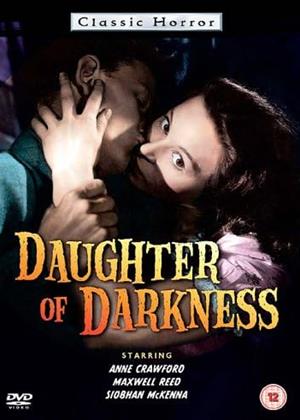
Postwar Gothic thriller featuring Britain's first female serial killer. In the small Irish town of Ballyconnen, Emmy Baudine (Siobhan McKenna) is a beautiful but disturbed young woman who works for the local priest. When the carnival comes to town, she encounters a handsome young boxer called Dan (Maxwell Reed) - and lays his face open with her fingernails when he expects sexual favours form her. Hurriedly packed off to Yorkshire by Father Corcoran (Liam Redmond), Emmy is taken in by a farming family and manages to suppress the strange feelings of fascination and revulsion that she experiences in the presence of the opposite sex. Until, that is, the carnival comes to town and she finds herself face to face with the vengeful Dan... - Actors:
- Anne Crawford, Siobhan McKenna, Maxwell Reed, George Thorpe, Barry Morse, Liam Redmond, Cyril Smith, Honor Blackman, Denis Goacher, Grant Tyler, Norman Shelley, George Merritt, Ann Clery, Arthur Hambling, David Greene, Leslie Armstrong, Iris Vandeleur, Lindsay Hooper, Alexis Milne, Bartlett Mullins
- Directors:
- Lance Comfort
- Producers:
- Victor Hanbury, A.R. Shipman
- Writers:
- Max Catto
- Studio:
- Simply Media
- Genres:
- Classics, Drama, Horror, Thrillers

More like Daughter of Darkness

Reviews (1) of Daughter of Darkness
Inheritance of Night - Daughter of Darkness review by griggs
Something dark stirs beneath the moors and mist in Daughter of Darkness, a British oddity that straddles gothic/folk horror and kitchen-sink melodrama, with a side of repressed hysteria. Our protagonist—haunted, hunted, and unnamed for long stretches—is shuffled from rural Ireland to Yorkshire under a cloud of suspicion, but no one bothers to say quite why. The local women despise her, the men can’t leave her alone, and both treat her like a curse in petticoats.
It’s radical for 1948: a female anti-hero who plays the church organ at midnight, communes with a dog, and may or may not be a killer. She’s either a danger or a scapegoat, but either way, she’s the one people chase with pitchforks. There’s Catholic guilt, barn-burning, Traveller stereotypes, and a travelling fair thrown in for good measure. And yes, that is a young Honor Blackman, already showing the flinty poise she’d later perfect.
Tonally, it’s a spiritual cousin to Black Narcissus—religious guilt, isolation, and erotic repression bubble just beneath the starched surface. Structurally, it prefigures The Wicker Man’s outsider-vs-village paranoia, Repulsion’s descent into psychosis, and the feminist rage of The VVitch. You could even argue it sets the table for The Blood on Satan’s Claw and Witchfinder General, sowing the seeds of British folk horror before the term existed. And in its portrait of a young woman feared, punished, and possibly empowered by her sexuality, it quietly echoes through Carrie, The Others, and Saint Maud.
Not everything makes sense, but there’s a sad, murky pull to it—a portrait of a woman punished for being wanted, feared for not being understood. Mystical, bleak, and definitely not your average British B-picture.