Rent Rose of Nevada (2025)
3.2 of 5 from 99 ratings
1h 54min
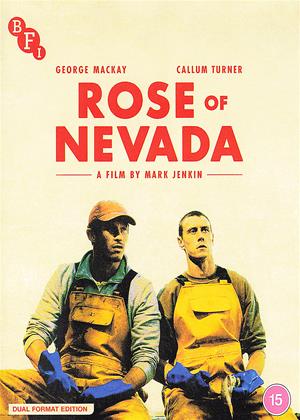

I went in wary after bouncing hard off Enys Men, but Rose of Nevada turned out to be much more my speed. It’s still unmistakably Mark Jenkin – scratchy 16mm textures, post-synced voices, slightly off-kilter cutting – but this time that style is wrapped around an actual ghost-ship yarn with a clearer spine.
A trawler lost 30 years ago drifts back into a battered Cornish harbour, and two men sign on hoping for a fresh start. From there it slides, almost casually, into time-slip territory. Past and present bleed into each other as the Rose creaks in the swell, radios crackle and the gulls sound just a bit wrong. Jenkin’s Cornwall feels properly lived-in: the weary pub, the half-forgotten quay, the sense of a place left behind.
George MacKay, as ever, is rock solid, wearing the film’s strangeness like it’s the most natural thing in the world, with Callum Turner a nice, needling foil. It still won’t convert everyone to Jenkin’s wavelength, and a stretch or two is a touch baggy, but once it locks in, it’s oddly, eerily captivating.
Director Mark Jenkin has a unique approach to filmmaking - implementing old tech hardware and dubbing the sounds on later, his movies are certainly an acquired taste. Rose of Nevada is his third feature and you should know what to expect - stilted acting and a liberal respect of linear coherent narrative. If you don't mind the mysterious nature of its storyline and are happy to piece it all together afterwards, The Rose of Nevada really is something special. It's a timemachine/ghost story that falls somewhere between Jenkin's relatable BAIT and his elusive arty ENYS MEN. At a glance, the plot may look like a Cornish Event Horizon but it's so much more... :)
Mark Jenkin’s singular, uncompromising style remains unchanged: hand-cranked, grainy 16mm film brought to imperfect life with scratches, fibres and lens flare, and a post-synched soundtrack that lends his films an uncanny vibe. This one feels thematically familiar too, sharing Bait’s grief over lost fishing communities and Enys Men's haunting qualities. But Jenkin weaves a whole new tale of the unexpected here: one that will leave you scratching your head and smelling of fish.
The time-travel premise sounds high-concept, but Jenkin is more interested in a nightmarish, dreamlike ambience, evoked by rhythmic sound and images and fractured editing, than a propulsive, clearly determined narrative. Ambiguity is everything here, which will either invite you to consider myriad allegorical readings — climate change, Brexit, industrial decline and the cost-of-living crisis are all hinted at — or just put you off altogether. The script suggests that what the characters are experiencing has to do with the ways in which the past is imagined; perhaps notions of a better past have more to do with our own anxieties about our present than the bygone realities and how older generations may have conducted their lives. 'Rose of Nevada' leaves us with a paradox: the past that abruptly appears seems desirable and inviting, offering the fishermen prosperity and a sense of purpose. Multiple readings are possible.
What’s undeniable, though, is that Jenkin’s filmmaking is the star of the show. Mesmerising shots of rusted metal, weathered woodwork and flourishing lichen signify a world in decay while, perversely, primary colours — the blue Cornish sky, Callum Turner’s pink baseball cap — pop off the screen and slap us in the face. Compelling stuff.