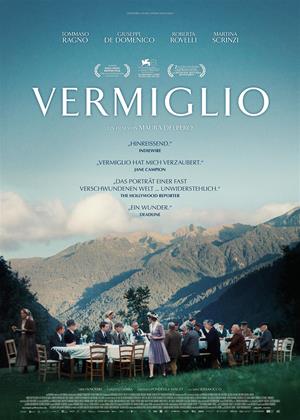
Vermiglio (2024)
- General info
- Available formats
- Synopsis:
- In 1944, the arrival of Pietro (Giuseppe De Domenico), a Sicilian soldier, in remote Vermiglio upends the daily life of a teacher and his family, while Lucia (Martina Scrinzi), his eldest daughter, falls in love with him and decides to marry him. At the end of the war, Pietro returns to Sicily, and Lucia gives birth to a child. The family learns from the newspaper that Pietro, who was already married to a Sicilian woman, has been killed by her. Lucia has no choice but to entrust the child to an orphanage.
- Actors:
- Tommaso Ragno, Roberta Rovelli, Martina Scrinzi, Giuseppe De Domenico, Carlotta Gamba, Orietta Notari, Santiago Fondevila, Rachele Potrich, Anna Thaler, Patrick Gardner, Enrico Panizza, Luis Thaler, Simone Benedetti, Sara Serraiocco, Leone Gubert
- Directors:
- Maura Delpero
- Producers:
- Francesca Andreoli, Maura Delpero, Santiago Fondevila, Leonardo Guerra Seràgnoli
- Writers:
- Maura Delpero
- Genres:
- Drama
- Countries:
- Italy
More like Vermiglio

Reviews (1) of Vermiglio
Tender, slowly unfolding family drama set in pre-war Italy - Vermiglio review by PD
Set to the rhythm of the changing seasons in the high Italian Alps, Maura Delpero’s film is a graceful and tender, slowly unfolding piece involving us in the lives of many different characters, with wider observations on the aspects of social change affecting women at the end of the Second World War.
The time is 1944 (although it could easily be 1914), when young men were away in uniform fighting and only womenfolk, children and a few elderly men were left to carry on the farmwork and homesteads. The house of the Grazidei family is in many ways a safe haven for its incumbents, but also one under the tutelage of a commanding father (Tommaso Ragno). This anomaly is immediately striking: even taking into account the period’s high infant mortality rate, the family seems over-populated and the expression “one more mouth to feed” an understatement. It is clear that this sensitive, cultivated man who loves teaching is also a traditional patriarch who makes all the decisions in the house, including some bad ones regarding his children’s future. Another oddity is the presence of Pietro, a young Sicilian deserter who is in hiding from the army with the complicity of the villagers. In spite of – or because of – the language and culture gap, he and the teacher’s eldest daughter Lucia are drawn to each other. What leads to the fatal denouement here – a shocker by any standard – is a moral failing that village tradition cannot forgive. It leaves the family turned upside down, and even their strong family bonds seem to unable to heal the psychological wounds.
Vermiglio is a film that proceeds carefully with few narrative missteps, until the ending sends Lucia on a highly improbable journey across Italy that upsets the tale’s strong sense of geographical unity, leaving us wishing perhaps for a more convincing ending. Still, the portrait of a nearly vanished rural way of life remains compelling, the film’s initial lightness and peace gradually giving way to a bleakness, a sense of entrapment, giving us a clear-eyed look at the social structures traditional Catholicism serves to camouflage.