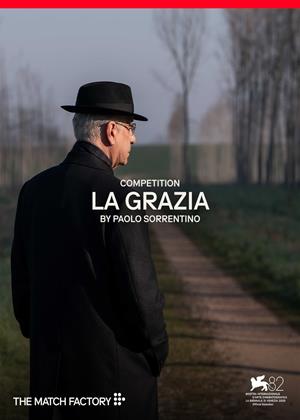
La Grazia (2025)
- General info
- Available formats
- Synopsis:
- A widowed Italian president faces moral crises over euthanasia legislation and pardoning killers while grappling with his late wife's infidelity during his final months in office.
- Actors:
- Toni Servillo, Anna Ferzetti, Orlando Cinque, Massimo Venturiello, Milvia Marigliano, Giuseppe Gaiani, Giovanna Guida, Alessia Giuliani, Roberto Zibetti, Linda Messerklinger, Vasco Mirandola, Rufin Doh Zeyenouin, Guè Pequeno, Ahmad Alameldeen, Simone Colombari, Alexandra Gottschlich, Francesco Martino
- Directors:
- Paolo Sorrentino
- Producers:
- Annamaria Morelli, Andrea Scrosati, Paolo Sorrentino
- Writers:
- Paolo Sorrentino
- Aka:
- Grace
- Genres:
- Drama
- Countries:
- Italy
More like La Grazia

Reviews (1) of La Grazia
Tender and powerful study of the moral dilemmas of leadership - La Grazia review by PD
Paolo Sorrentino’s latest is a captivating portrait of an esteemed political leader in the waning days of his term. For the most part it’s a sober film, but it’s not without the customary creative arias, the playful humour and visual delights that have distinguished Sorrentino’s best work, and features a quite wonderful turn by Toni Servillo as Mariano De Santis, a fictional president of the Italian Republic. He describes himself as “a grey, boring man, a man of the law,” but instead is revealed to possess a wellspring of deep feeling, humanity and — to his own surprise — doubt.
With La Grazia, Sorrentino makes the radical and (these days) original choice of imagining a senior politician being an honest man of integrity; he's intelligent and principled but needled by ethical uncertainties over choices he faces during his final days in office, together with a complex personal history. The absence of corruption, scandal, self-dealing and cronyism makes this a somewhat unreal break from present-day concerns, but the reflections on power, influence and the weight of the past are unquestionably relevant.
De Santis’ face is generally as unyielding as the Palazzo del Quirinale, the official residence of Italian presidents. Eccentrically, his only pleasure is listening to rap music on his earphones (Sorrentino, as often before, supplies plenty of distinctive electro-pop on the soundtrack), but Servillo’s characterisation allows for subtle hints of the man’s vanity; he also seems unsure whether to be amused or offended when he discovers his nickname is “Reinforced Concrete.” With just six months left in his term, the former judge’s duties have decelerated to the point where one of the proposed items on his agenda is an interview with the editor of ‘Vogue’ about his sartorial choices, but three matters occupy thick folders on his desk. One is a law to legalise euthanasia, which has wide support, including from his daughter Dorotea. “If I don’t sign, I’m a torturer. If I sign, I’m a murderer,” says De Santis. The others are requests for pardons: one for a popular history teacher who killed his wife when she reached the advanced stages of Alzheimer’s, the other for a young woman convicted of murdering her husband in his sleep. Sorrentino’s script neatly intertwines these concerns, cleverly pondering the difference between the truth absorbed up close and the law, which is viewed from a distance.
The film is punctuated by poignant moments of reflection in which Mariano sneaks cigarettes on the Quirinale roof while sharing confidences with Colonel Labaro, his cuirassier, the elite cavalry regiment that serves as the president’s guards. Other introspective angles are explored during Mariano’s audiences with his friend the Pope, a serene Black man with a head crowned by a bundle of silver dreads, to whom Mariano confesses his loneliness since his adored wife Aurora’s passing (the film increasingly becomes a story about love as Mariano ruminates on his past relationship with Aurora). The Pope doesn’t offer empty words of pious comfort, instead telling the politician that his life has become weighted down when what he wants is “leggerezza,” or lightness. There are also beautifully observed moments such as the illness of Mariano’s favourite horse, whilst two set pieces are fabulous: one involving Mariano as guest of honour at a veterans’ dinner for Italy’s mountain infantry, the Alpini, and another where he hosts an official reception for the Portuguese president and simply looks on motionless as the visitor attempts to process toward him across a courtyard in the driving rain: a dream image of the vulnerability and absurdity of official pomp.
La Grazia is visually arresting, but it’s the film’s warmth, its spirit of forgiveness, understanding and hard-won wisdom that grips us; or to borrow from the title, its 'grace', an Italian word also for official pardons. A tender and powerful piece.