

One hundred years ago, a London mother-to-be was trying to find a publisher for her first book. Several companies had rejected the whodunit featuring a Belgian detective with an outsize moustache, which had been written on Dartmoor in 1916 while its author was working as an unpaid nurse in a Torquay hospital during the Great War. Today, Agatha Christie is known as 'the Queen of Crime' and is the world's biggest-selling novelist. Cinema Paradiso investigates how her work has been adapted for the screen.
Only William Shakespeare has sold more books than Agatha Christie. With global sales around two billion, she has been translated into over 100 languages. Moreover, her 1952 play, The Mousetrap, is the longest-running production in theatre history and is still going strong after over 27,000 performances. However, a contract clause signed back in 1956 means that no one can make an English-language version of the story until six months after the show closes. Fortunately, Christie didn't impose similar restrictions on her other works, as over 30 features and countless TV adaptations have been made since the silent duo of Fred Sauer's Adventure Inc. and Julius Hagen's The Passing of Mr Quin (both 1928).
How Monosyllaba Found Her Voice
Born in Torquay in 1890 to an American father and a British mother, Agatha Mary Clarissa Miller was home-schooled until the age of 11 and became a voracious reader. She wrote her first short story while recovering from illness, but her first novel, Snow Upon the Desert, which she penned under the pseudonym Monosyllaba, has yet to be published. Having experimented with a series of supernatural short stories, Agatha was dared by her sister Madge to produce a full-length thriller.
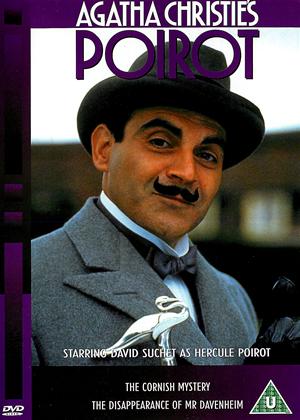
So, with husband Archie Christie on active service during the First World War, she began work on The Mysterious Affair at Styles, while nursing in Devon. Inspired by her love of Wilkie Collins and Sir Arthur Conan Doyle, the story introduced an egg-headed detective named Hercule Poirot, who was given Belgian nationality because Christie had befriended several wounded soldiers and refugees living in Torbay. In 1989, the tale came to television, as David Suchet played the eccentric sleuth exercising 'the little grey cells' in the first episode of the third season of ITV's Poirot series and it's available to rent in a stand-alone edition from Cinema Paradiso.
Poirot was first played on stage by Charles Laughton in Alibi (1928), which was adapted from a play based on The Murder of Roger Ackroyd, which many believe to be Christie's most ingenious scenario and can be found in Agatha Christie's Poirot: Collection 5. However, when Leslie S. Hiscott came to make the film version three years later, the lead went to Austin Trevor because he specialised in continental accents.
Curiously, Trevor's Poirot lacked the famous tash in Alibi, Black Coffee (1931) and Lord Edgware Dies (1934). Consequently, after Christie vetoed the casting of Zero Mostel, Tony Randall became cinema's first authentic Poirot in Frank Tashlin's The Alphabet Murders (1965), a quirky comic venture that so displeased Christie that she refused to contemplate further Poirot pictures until Lord Louis Mountbatten persuaded her to sell the rights to Murder on the Orient Express to his producer son-in-law, Lord John Brabourne, in 1973.
A Real-Life Mystery
We shall return to this Oscar-winning project later, as well as the Suchet and John Malkovich versions of The ABC Murders. But success didn't suit Christie and she vanished for 10 days in 1926. On discovering her husband's affair with Nancy Neele, she abandoned her car near a Surrey quarry and checked into a Harrogate hotel as South African Teresa Neele. As she had sent the police a letter suggesting that she feared for her life, Archie came under suspicion, while fellow crime writers Arthur Conan Doyle and Dorothy L. Sayers (five of whose Lord Peter Wimsey cases starring Ian Carmichael are available from Cinema Paradiso) involved themselves in an investigation that made front-page headlines.
This episode has been the subject of Michael Apted's Agatha (1979), as well as the TV-movies Agatha Christie: A Life in Pictures (2004) and Agatha and the Truth of Murder (2018), with Vanessa Redgrave, Olivia Williams and Ruth Bradley respectively playing the missing author, whose life has also been covered in such documentaries as Agatha Christie's Garden: Murder and Mystery in Devon (2006) and Agatha Christie: The Queen of Crime Fiction (2011).
Eventually, Christie was recognised and speculation swirled that she had either been suffering from amnesia or had been wreaking revenge upon her treacherous spouse. Some even suggested she had merely been engaged in a publicity stunt to boost sales of her next book. But she returned to her desk and, having married archaeologist Max Mallowan in 1930, Christie became so celebrated that her waxwork was placed near Alfred Hitchcock's in Madame Tussaud's.
Page, Stage and Screen
In between occasional romantic trifles under the name Mary Westmacott, Christie continued to produce novels and short stories at a prolific rate. One of the latter, 'Philomel Cottage', was adapted for the stage and brought Christie to Hollywood when it was filmed by Rowland V. Lee as Love From a Stranger (1937), with Ann Harding and Basil Rathbone.
The most adapted Christie story until the late 1950s, 'Philomel Cottage' was first published in The Listerdale Mystery and other tales from this volume and Parker Pyne Investigates (both 1934) provided the material for The Agatha Christie Hour (1982), a 10-part ITV series that is available from Cinema Paradiso and showcases a host of familiar faces in some teasingly diverse vignettes. The following year, ITV produced Agatha Christie's Partners in Crime, a series of 11 cases that teamed Francesca Annis and James Warwick as Tommy and Tuppence Beresford. They had been renamed Pierre Lafitte and Lucienne Fereoni when played by Carlo Aldini and Eve Gray in Fred Sauer's Adventure Inc. and this daring duo would be renamed Bélisaire and Prudence Beresford when French director Pascal Thomas cast André Dussollier and Catherine Frot in three delightfully offbeat offerings: By the Pricking of My Thumbs (2005), Crime Is Our Business (2008) and Partners in Crime (2012).
The first picture coincided with Peter Medak's mischievous pairing of Tommy and Tuppence with Miss Marple in a variation on By the Pricking of My Thumbs that saw Geraldine McEwan (more of whom anon) joining forces with Anthony Andrews and Greta Scacchi. A decade later, David Walliams and Jessica Raine took over as the Beresfords in Partners in Crime (2015) series, which saw them crack two cases in 'The Secret Adversary' and 'N or M?'. Frustratingly, after some mixed reviews, the BBC decided not to commission a second series. But the critics don't always get it right. Rent the disc for yourself and make up your own mind.
The latter story got Christie into trouble, as it included a character named Major Bletchley and she was investigated by MI5 to check she hadn't given away the name of the top-secret coding facility at Bletchley Park, which has featured in such films as Michael Apted's Enigma (2001) and Morten Tildum's Alan Turing biopic, The Imitation Game (2014). In fact, Christie made a positive contribution to the war effort, as she nursed wounded soldiers again. Indeed, during her stint at University College Hospital in London, she picked up a working knowledge of poisons, which proved useful when she resumed writing full-time after moving to Winterbrook, a village near the Oxfordshire town of Wallingford, which is the main location for ITV's Midsomer Murders, which has run for 122 episodes over 20 series since 1997.
By the end of the war, Christie had reinforced her reputation in the United States with the success of René Clair's And Then There Were None (1945), a fiendish mystery that has since been reworked as Ten Little Indians by British director George Pollock in 1965 and Russian Stanislav Govorukhin in 1987. It has also been filmed in 1974 by Peter Collinson as And Then There Were None, the title which Craig Viveiros used for a 2015 BBC adaptation that featured Aidan Turner, Miranda Richardson, Sam Neill and Charles Dance. Moreover, it provided the basis for Neil Simon's droll parody, Murder By Death, which was filmed in 1976, with James Coco as Milo Perrier and Elsa Lanchester as Jessica Marbles. Even Family Guy got in on the act by borrowing the premise of guests being stranded in an old dark house on a remote island for 'And Then There Were Fewer' (2010), which is available on Series 10 of the long-running animated series.
Having missed out on the chance to play Poirot in 1931, Charles Laughton finally got to make an Agatha Christie picture when Billy Wilder cast him as cantankerous lawyer Sir Wilfrid Robarts in Witness For the Prosecution (1957), which was based on another of Christie's popular stage plays. Tyrone Power and Marlene Dietrich found themselves under cross-examination, while Diana Rigg and Beau Bridges came under Ralph Richardson's scrutiny in Alan Gibson's 1982 tele-remake.
In 2016, the querulous QC was renamed John Mayhew for Toby Jones to steal the spotlight in quizzing Billy Howle and Andrea Riseborough in Julian Jarrold's take on Witness For the Prosecution, which arrived on the West End stage in 1953, as Christie was working on The Spider's Web, which she had written at the request of British actress Margaret Lockwood, who also starred in a 1955 TV adaptation. Only The Mousetrap has been performed more often and Godfrey Grayson's 1960 feature version was followed by the BBC take on The Spider's Web (1982), which starred Penelope Keith as the diplomat's wife who finds an inconvenient corpse in the drawing-room of her rented home.
Enter Miss Marple
While Poirot became an international jet-setter who revelled in his fame, Jane Marple preferred to remain in the rustic village of St Mary Mead. Inspired by Christie's grandmother, she had first appeared in 'The Tuesday Night Club', a 1927 short story that was recycled as the first chapter of The Thirteen Problems (1932). Miss Marple's first novel-length case was The Murder At the Vicarage (1930), while she debuted on screen in the guise of Gracie Fields in a 1956 American TV adaptation of A Murder Is Announced. However, Christie couldn't bear to watch Margaret Rutherford's incarnation of her spinster sleuth and confided to her agent that she was ashamed of having sold the rights to MGM because she had sacrificed her literary integrity.
Some regard Rutherford's four outings with great affection, however. With their jaunty Ron Goodwin scores, they were directed by George Pollock and saw the actress's husband, Stringer Davis, play her librarian sidekick, Jim Stringer, even though he doesn't appear in any of Christie's books. The first case, Murder, She Said (1961), was based on 4:50 From Paddington and featured a future Miss Marple, Joan Hickson, as the housekeeper. Reuniting Rutherford with Australian stalwart Charles 'Bud' Tingwell as Inspector Craddock, Murder At the Gallop (1963) infuriated Christie fans because the source novel, After the Funeral, had been an Hercule Poirot case. There was less furore over Murder Most Foul, which drew on Mrs McGinty's Dead and co-starred Tuppence-in-waiting Francesca Annis. But Murder Ahoy (both 1964) cut Christie out of the loop altogether, as screenwriters David Pursall and Jack Seddon concocted their own mystery that required Rutherford to don an admiral's uniform to investigate dodgy dealings aboard the merchant marine training ship, HMS Battledore.
Despite the fact Rutherford made a cameo in The Alphabet Murders (which Christie's circle advised her not to watch), The Mirror Crack'd From Side to Side (1962) was dedicated 'To Margaret Rutherford, in admiration.' With its title truncated to The Mirror Crack'd, Guy Hamilton's 1980 whodunit did much to land Angela Lansbury the plum role of Jessica Fletcher in Murder, She Wrote (1984-1995), which she took after plans to film A Murder Is Announced as Appointment With Murder fell through. But, despite the stellar cast, the modest box-office returns meant that this remains Hollywood's last cinematic brush with Miss Marple, who has only since been played on the big screen by Estonian Ita Ever in Vadim Derbenyov's A Pocketful of Rye (1985). She has, however, been essayed by Kim Yun-jin in a South Korean TV series and voiced by Kaoru Yachigusa in the Japanimation show, Agatha Christie's Great Detectives Poirot and Marple (2004-2005), in which Kotaro Satomi played the Belgian, whose assistant is Miss Marple's niece.
The Oscar-winning Helen Hayes assumed the role for Robert Michael Lewis's A Caribbean Mystery (1983) and Dick Lowry's Murder With Mirrors (1985). Since when, Miss Marple has been played on TV by a trio of British actresses, Joan Hickson, Geraldine McEwan and Julia McKenzie.
A character player who had made her stage debut in 1927, Joan Hickson took her first feature credit in Cyril Gardner's Widow's Might (1935) and went on to rack up over 235 film and television appearances over the next six decades. Yet, while most people knew the face, few would have been able to name the actress playing all those shrewish wives, starchy matrons and snooty neighbours. Agatha Christie recognised her talent, however, and, after seeing her in a 1940s stage production of Appointment With Death, she sent Hickson a note that read: 'I hope one day you will play my dear Miss Marple.'
Sadly, Christie died eight years before she could see Hickson appear to the manor born in Silvio Narizzano's The Body in the Library (1984), the first of 12 BBC adaptations that remained faithful to the original novels and earned the unanimous approval of critics and fans alike. Over the next eight years, Hickson became a national treasure in The Moving Finger, A Murder Is Announced, A Pocketful of Rye (all 1985), Murder At the Vicarage (1986), Sleeping Murder, At Bertram's Hotel, Nemesis, 4:50 From Paddington (1987), A Caribbean Mystery (1989), They Do It With Mirrors (1991) and The Mirror Crack'd From Side to Side (1992). Indeed, not only did she receive two BAFTA nominations, but Hickson was also commended by Queen Elizabeth II, who confided during her OBE investiture that she played the part 'just as one envisages it'.
Retiring from the role, but not from acting, Hickson had restored Miss Marple to Christie's conception of a keen people watcher with an acute understanding of human nature. Despite its picture book aspect, St Mary Mead was anything but cosily nostalgic, however, as Christie often focused on cruelty, claustrophobia, resentment and paranoia in devising whodunits that always presented readers and viewers with the same information as the detective, so that they had a chance to solve the mystery for themselves. She also had a fine ear for dialogue, which makes it such a shame that ITV's series, Agatha Christie's Marple (2004-13), opted to pastiche the Christie style in a manner that she would never have allowed during her time as president of Wallingford's Sinodun Players amateur dramatic troupe (1950-75).
Having followed Oscar winner Maggie Smith into the title role of The Prime of Miss Jean Brodie (1978) and having won a BAFTA alongside Charlotte Coleman in Beeban Kidron's tele-adaptation of Jeanette Winterson's Oranges Are Not the Only Fruit (1989), respected stage star Geraldine McEwan represented quite a casting coup. But, while she twinkled infectiously as Miss Marple in The Body in the Library (2004), not everyone was convinced by the tone of Kevin Elyot's teleplay. However, McEwan continued to enjoy herself in The Murder At the Vicarage, 4:50 From Paddington and A Murder Is Announced and she returned for a second series to confound the killers in Sleeping Murder, The Moving Finger, The Sittaford Mystery and the aforementioned bowdlerisation of By the Pricking of My Thumbs (all 2005).
Despite the critical cavils that the producers were trivialising Christie's oeuvre, the third season proved reasonably popular, with At Bertram's Hotel and Ordeal By Innocence (both 2007) being followed by Towards Zero and Nemesis (both 2008), which were directed by Nicolas Winding Refn, a Danish director who had made his name with The Pusher Trilogy (1996-2005). But, as Towards Zero wasn't a Christie Marple, any hopes he would bring a Nordic noir touch to St Mary Mead were dashed, as aficionados complained about the liberties being taken with Christie's manuscripts.
As anyone who had seen Desmond Davis's 1984 film adaptation of Ordeal By Innocence would know, Miss Marple doesn't figure in the storyline. But, even though Sarah Phelps removed her from the three-part 2018 version of Ordeal By Innocence that Sandra Goldbacher directed for the BBC, she made drastic changes of her own by changing the identity of the killer. Admirers of Sidney Gilliat's interpretation of Endless Night (1971) would also have been surprised to see Julia McKenzie's Marple pop up to piece together the clues in the final episode of Series Six (2013), as she had nothing to do with this story before screenwriter Kevin Elyot intervened. The previous season had also seen Russell Lewis and Paul Rutman respectively convert The Pale Horse and The Secret of Chimneys into Marple mysteries, while Stephen Churchett and Patrick Barlow had done the same with Murder Is Easy and Why Didn't They Ask Evans? in Series Four.
Prior to her short stint as Miss Marple, Helen Hayes had appeared in Claude Whatham's Murder Is Easy (1982), whose original detective was Superintendent Battle, who found himself being Gallicised as Commissaire Martin Battle (François Morel) in Pascal Thomas's Towards Zero (2007). Similarly, before they became the Beresfords, Francesca Annis and James Warwick had teamed in John Davies and Tom Wharmby's 1980 tele-take on Why Didn't They Ask Evans? which not only co-starred John Gielgud, Bernard Miles and Eric Porter, but also Joan Hickson, as one of the suspects. Unlike the McKenzie Marples, this handsome adaptation is available from Cinema Paradiso, as is Charles Beeson's solid version of The Pale Horse (1997), with Hermione Norris, Leslie Phillips and Andy Serkis in the impressive cast, and Dhund (1973), which Indian director B.R. Chopra adapted from Christie's 1958 play, The Unexpected Guest.
This wasn't Bollywood's first stab at Christie, however, as Raja Nawathe's Gumnaam (1965) bears an unacknowledged debt to And Then There Were None, as does giallo maestro Mario Bava's Five Dolls For an August Moon (1970). Moreover, Christie's novels have also been adapted for the screen in Germany, Holland, Italy, Portugal, Hungary, Poland, Greece, Lebanon and Brazil. Some films are also Christie's in disguise, including Patrick Dewolf's Innocent Lies (1995), which departed so dramatically from the text of Towards Zero that the author's daughter, Rosalind Hicks, ordered the producers to change the title and the name of the character to avoid obvious association with her mother's work.
The Little Grey Cells
Albert Finney remains the only actor to receive an Oscar nomination for playing one of Agatha Christie's celebrated sleuths. But, while his BAFTA-winning Poirot was splendidly fastidious in Sidney Lumet's Murder on the Orient Express (1974), it was co-star Ingrid Bergman who went home with the golden statuette for her poignant performance as meek nanny Greta Ohlsson in a story that was inspired by the notorious Lindbergh baby kidnapping case. It has been retold three times, with Alfred Molina playing Poirot in Carl Schenkel's 2001 version before David Suchet's 2010 take was followed by Kenneth Branagh's 2017 feature, in which he gave Poirot outrageously large whiskers.
Branagh is currently in pre-production on a reworking of Death on the Nile, which had been Peter Ustinov's first case as Poirot in 1978, when John Guillermin assembled a cast that had included Bette Davis, David Niven, Maggie Smith, Mia Farrow and future Miss Marple, Angela Lansbury. Bringing a touch of whimsical wit to the role, Ustinov lorded it over equally starry casts in Guy Hamilton's Evil Under the Sun (1982) and Michael Winner's Appointment With Death (1988) before moving on to the small screen for Thirteen At Dinne (1985), Dead Man's Folly and Murder in Three Acts (both 1986). The latter triptych is not currently available, which is a shame as the first features David Suchet as Inspector James Japp. He claims he gave the worst performance of his career, but he made amends when he played Poirot to Philip Jackson's Japp and Hugh Fraser's Captain Arthur Hastings, in Lord Edgware Dies, which was transmitted as part of Series 7 of ITV's Agatha Christie's Poirot.
There's no question that Suchet is the definitive Poirot, although not all of the 70 episodes he made between 1989-2013 are of the same high quality. Set between 1935-39, the stories varied in length, with those made before Series 6 running to 50 minutes and those in the final eight seasons clocking in between 90-100 minutes. Despite never having read a Poirot novel, the 41 year-old Suchet had misgivings about accepting the role. However, on signing up, he read every case and compiled a dossier on the detective so that he knew everything about him. As he researched, he discovered he had a good deal in common with the Belgian, whom he claimed became his best friend between making The Adventure of the Clapham Cook and Curtain: Poirot's Last Case.
The majority of the episodes can be found on Cinema Paradiso by typing Suchet's name into the search line. Naturally, opinion is divided as to which are the best. Suchet's own favourite is reportedly Wasp's Nest, which shares as a disc with The Plymouth Express (1991). But allow us to point you in the direction of Third Floor Flat (1989), Peril At End House, The Cornish Mystery, The Adventure of the Cheap Flat, The Mysterious Affair At Styles (all 1990), Death in the Clouds (1992), The Chocolate Box (1993), Hercule Poirot's Christmas (1994), Dumb Witness (1997), Evil Under the Sun, Five Little Pigs, Sad Cypress (all 2003), Death on the Nile (2004) and Cards on the Table (2005).
Suchet's version of The ABC Murders (1992) is also well regarded. but not everyone bought into John Malkovich's radical reinterpretation of Poirot in the BBC's 2018 adaptation, which is now available on disc. Over 40 years after Agatha Christie's death, the public appetite for screen versions of her novels and stories remains as insatiable as ever. Even non-Poirot and Marple titles have their cachet, with Tristram Powell reinventing recurring character Colonel Race as Colonel Reece so that Oliver Ford Davies and Pauline Collins could play a variation on Tommy and Tuppence in Sparkling Cyanide (2003). Interestingly, this story was repurposed for Suchet's Poirot by Anthony Horowitz as Yellow Iris (1993).
Among the other stand-alones is Crooked House, one of the many titles that Christie derived from a nursery rhyme. In 2011, Julie Andrews, Gabriel Byrne, Gemma Arterton and Matthew Goode were reported to have joined the cast of Neil La Bute's adaptation. But, while Downton Abbey creator Julian Fellowes remained among the writers, a change of rights holder saw Gilles Paquet-Brenner take the helm of the 2017 feature that starred Glenn Close, Max Irons, Gillian Anderson and Terence Stamp. So, while the French enjoy the long-running series, Les Petits meurtes d'Agatha Christie (2014-), we shall have to wait patiently for the next incarnation of Miss Marple (and, rest assured, there will be one), some overdue adaptations of the Mary Westmacott novels, and the BBC's forthcoming takes on They Came to Baghdad and Death Comes At the End, which is unique in the Christie canon for being set in Ancient Egypt.