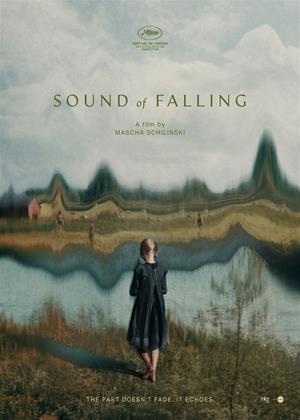
Sound of Falling (2025)
- General info
- Available formats
- Synopsis:
- The film follows four girls - Alma (Hanna Heckt), Erika (Lea Drinda), Angelika (Lena Urzendowsky), and Lenka (Laeni Geiseler) - from different historical periods (shortly before World War I, at the end of World War II, in East Germany during the 1980s, and during the early 21st century, respectively) whose lives are subtly interconnected. Each spends their youth on the same four-sided farmstead in the Altmark region. Some of the children are subjected to sexual assault, abuse, and incest. As they move through their respective presents, traces of the past gradually emerge.
- Actors:
- Hanna Heckt, Lena Urzendowsky, Susanne Wuest, Luise Heyer, Laeni Geiseler, Lea Drinda, Florian Geißelmann, Gode Benedix, Bärbel Schwarz, Lucas Prisor, Konstantin Lindhorst, Martin Rother, Filip Schnack, Ninel Geiger, Greta Krämer, Luzia Oppermann, Zoë Baier, Anastasia Cherepakha, Liane Düsterhöft, Helena Lüer
- Directors:
- Mascha Schilinski
- Producers:
- Burkhard Althoff, Melvina Kotios, Lasse Scharpen, Lucas Schmidt, Maren Schmitt
- Writers:
- Louise Peter, Mascha Schilinski
- Aka:
- The Doctor Says I'll Be Alright, But I'm Feelin' Blue / In die Sonne schauen
- Genres:
- Action & Adventure, Drama
- Countries:
- Germany
More like Sound of Falling

Reviews (2) of Sound of Falling
Generations of Guilt and a Very Haunted Farmhouse - Sound of Falling review by griggs
This felt like someone had taken a haunted farmhouse, a family curse, a history textbook and a fever dream, then chucked them in a blender and somehow made it work. Sound of Falling jumps across four time periods in the same German farmstead, with trauma, guilt and repression seeping through the walls like damp. It’s one of those films where every image feels loaded, even when you’re not fully sure what it’s loading.
What really got me was the atmosphere. The drifting camera, the groaning soundtrack, the sense that something awful happened here and never really stopped happening. It reminded me a bit of Mark Jenkin, not visually in a direct way, but in how it feels handmade, eerie and tuned into memory, place and unease. Some of it is opaque, fair warning, but I found it properly unnerving rather than just wilfully obscure.
When it finished, the man behind me leaned over and said, “Well that was weird.” Fair enough, really.
Highly original female-centred tale spanning four generations - Sound of Falling review by PD
This highly original second film from German director Mascha Schilinski’s ('In Die Sonne Schauen' in German), is a haunting, transfixing chronicle in which the lives of four girls are fused into one long cinematic tone poem, hopping between different epochs without warning, painting a portrait of budding womanhood and rural strife through the ages. The closest thing that comes to mind is perhaps Terrence Malick’s The Tree of Life, although this is Malick by way of Jane Campion and Michael Haneke, shifting between fleeting coming-of-age moments and scenes of resolute darkness and human cruelty. At two and a half hours, and without an easily discernible narrative, it will be of appeal only to the very patient, but they are rewarded by a work that reminds us how the cinema can still reinvent itself, as long as there are directors like Schilinski audacious enough to try.
Co-written with Louise Peter, the film’s collage-like structure tells four simultaneous stories though a series of fragments or snaphots (cameras of all types are depicted and used on screen), spanning a timeframe from the early 20th century all the way to the present. Set in the same massive farmhouse that passes down from one family to another, the film never strays too far from its main location, venturing out only to wander the nearby fields or dip into a river separating East and West Germany.
Characters come and go over the years, as cinematographer Fabian Gamper creeps around the house like a ghost discreetly recording events as they happen, catching both the many moments of torment but also flashes of occasional humour. Scenes become memories in other scenes, passed on from the living to the dead and back again, cut together so that they resonate more as time goes by and whilst the effect is a tad disorienting at first, you soon get used to it, and this is a piece whose power slowly accumulates as it progresses. The quartet of girls we follow — Alma (10 year-old Hanna Heckt - particularly impressive) after the turn of the last century, Erika after WWII, Angelika in the GDR of the 1980s and Lenka in the present — are not all related, though they share a common history that hangs over the house as both a blessing and a curse. There is trauma in their lives — sometimes deep unforgettable trauma that never seems to leave, but there is also beauty and self-discovery. Schilinski has essentially made four bildungsroman movies at once, each of them about young women awakening to the possibilities, as well as to the limits, that life has to offer them.
The film offers up an altogether unique kind of storytelling, one made up of momentary sensations, images, emotions and sounds that gradually form a bigger picture, depicting a world where young women face untold obstacles from one epoch to another, including rape, the death of loved ones, forced sterilisation, incest, and a form of rural slavery and prostitution, yet one in which they eventually emerge as arbiters of their own fates. Schilinski doesn’t spare us all their pain and suffering, nor does she hide the joy and wonder they sometimes experience; her brave girls carry their forebearers within them from one generation to the next, surging toward the future both wounded and victorious. Very impressive stuff indeed.