Rent The Long Walk (2025)
3.3 of 5 from 215 ratings
1h 44min
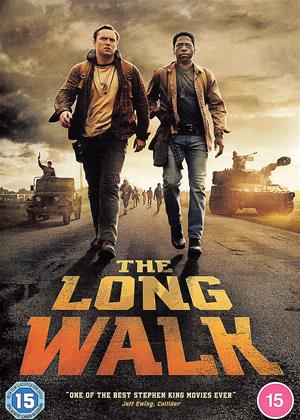

Picture the setup: near-fascist America turns adolescent misery into primetime entertainment, and the only rule is keep walking. Not a metaphor, not a motivational slogan — a commandment. The really creepy bit is that Stephen King cooked the idea up at university in the late ’60s, and here we are, decades later, treating it like a handy bit of fiction rather than a public service announcement.
But the film’s been marketed to death. The trailer doesn’t tease; it summarises. So the first stretch can’t build much dread, because you already know the route. Once the premise is established, the middle portion starts to repeat itself: warning, stumble, calculation, cruelty, rinse, repeat. That might be the point — systems are monotonous, brutality is boring — but cinema still needs rhythm, not just mechanism.
There are compensations. David Jonsson walks in with real screen electricity — the sort you can’t fake, the sort casting directors go feral for. Cooper Hoffman… I’m less sold. He’s fine, but he doesn’t quite anchor the thing the way it needs. Still, the friendship does register, which matters, because without that human thread it’s just a treadmill with bullets. And yes, Mark Hamill turns up, and if you don’t spot him straight away you’ll feel mildly foolish.I did.
The ending arrives and… sort of sits down. It isn’t outrageously bad, it’s just dutiful. Yet any “satisfying” alternative would be a cheat. This is a story about a machine. Machines don’t do catharsis. They do output.
Adapted from an early Stephen King novel this is a film that falls into the dystopian cycle of films where a future society devises some game or contest where it's win or die and designed to benefit society in some warped way; films such as Battle Royale (2000), The Hunger Games series, The Purge series or The Running Man (1987 & 2025) for example. Here in a collapsed USA, after some big war, society is in lethargy and the military control a televised contest where 50 teenage boys are selected by ballot to endure the Long Walk. Fall behind, break any of the rules or even slow down and you get shot until the last man standing wins riches beyond his dreams. This is meant to inspire people! The narrative is one that has to focus on the conversations between the contestants as they reveal their motives for competing and their various issues in the depressed lives they all lead. The deaths are often bloody and shocking but ultimately it's a film involving a lot of walking and talking. It's interesting enough highlighted by the presence of Mark Hamill as the nasty military man and Judy Greer as a worried mother of the main character played by Cooper Hoffman. It's ok but all feels a little too contrived and the ending seems both predictable in one way, surprising in another and ultimately a little disappointing.
No idea why others rate this movie. I doubt it would have been made had it not been based on a Stephen King 1966 unpublished novel.
It's an old theme, was then. Think the original DEATH RACE 2000, or indeed BRAVE NEW WORLD; or THE RUNNING MAN (watch the original Arnie version not the remade rubbish). Then there's the Hunger Games, made for teens like this is too - it's like a YA read - and the director of this directed the Hunger Games. Then the hit TV series SQUID GAME and plenty of novels, like the excellent 2016 RASMUS - A TELEVISION TALE - the 3rd part of that is like SQUID GAME before SQUID GAME with a Death Hunt reality TV Game Show in the streets of London.
I doubt King's novel had the tickbox black and Asian and native American faces/characters and that is rubbed in a tad too much imho. The USA is 12-13% black (UK just 4%, up from 3% a decade ago) but here it is 40%. I dislike preaching woke sermonising issue movies massively.
On the plus side, the film-makers do what so many movies do now and replace male characters in the original novel with female ones. They even discussed doing that with the TV adaptation of the classic novel LORD OFR THE FLIES recently. It seems male-only or mostly-male is problematic now, just as all-white is. so we get absurd colourblind casting with black/brown faces parachuted into historical drama. It is absurd. I am fine with black-only movies (MOONLIGHT) or female-only ones for female-themed ones - which is most movies now as it is most novels. BUT let's have more of the equal and opposite then!
The expected back story of main characters, the types, the tropes, the archetypes so no surprise for me how it all pans out. In a word, this is BORING.
Almost a 1 star. 1.5 stars rounded up.