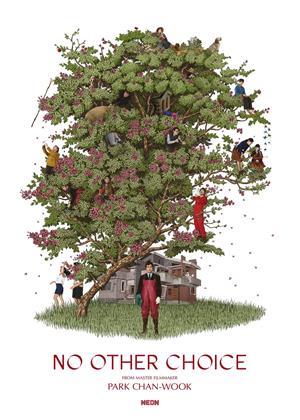
No Other Choice (2025)
- General info
- Available formats
- Synopsis:
- Yoo Man-Soo (Lee Byung-Hun) is married to Mi-Ri (Son Ye-Jin) and they have two children. They own their home that they bought with difficulty. Yoo Man-Soo has been working at a paper company for 25 years. He feels comfortable and satisfied with his life, but he is suddenly fired from his job. He struggles to find a new job to protect his family and his house.
- Actors:
- Byung-hun Lee, Ye-jin Son, Hee-Soon Park, Sung-min Lee, Hye-ran Eom, Seung-won Cha, Yeon-suk Ahn, Dal-su Oh, Lee Seok-hyeong, Yoon Ga-yi, Min-sik Choi
- Directors:
- Chan-wook Park
- Producers:
- Chan-wook Park
- Writers:
- Chan-wook Park, Lee Kyoung-mi, Jahye Lee, Don McKellar, Donald E. Westlake
- Aka:
- 徵人啟弒
- Genres:
- Comedy, Drama, Thrillers
- Collections:
- Award Winners, Oscar Nominations Competition 2026
- Countries:
- Korea
More like No Other Choice

Reviews (2) of No Other Choice
Where Survival Meets Delusion - No Other Choice review by griggs
No Other Choice turns job loss into a capitalist horror show, where survival and self-image blur until both are lethal. Lee Byung-hun’s Man-su is a paper executive who takes redundancy personally — so personally he starts eliminating the competition. What follows is part midlife crisis, part murder farce, all dressed in Park’s usual elegance and jet-black humour.
The film is equal parts humorous and exhausting, a satire wound so tightly it sometimes snaps. Beneath the slapstick and strings lies something genuinely tragic: a man who’d rather kill than change, in a system that rewards the impulse. Son Ye-jin brings warmth and weary logic as the wife left to pick up what’s left.
Stylish, savage, and strangely sympathetic, No Other Choice proves Park can still find humanity amid the bloodletting of modern ambition.
Ver watchable dark comedy with an anti-capitalist theme - No Other Choice review by PD
You have been fired. You have taken a menial job and are barely scraping together the family necessities. But wait! Now you are interviewing for a position for which you are superbly qualified! And you’ve been forewarned about the boss’s trickiest question! Unfortunately, however, you are in a Park Chan-wook film and he is in scathingly playful form, and so a bothersome shaft of sunlight means that however much you fidget in your seat you cannot angle its glare out of your eyes. You smile too wide at the interviewers’ unimpressed silhouettes, showing too many teeth. You are Mansu (Lee Byung-hun - absurdly brilliant throughout), and the film you don’t know you’re in is a delectable dark comedy.
We are immediately charmed onto Mansu's side, and we never really leave it, despite all the obviously terrible, ridiculous, often grisly things he’s about to do. This is because he has worked for decades managing a paper factory that abruptly lays him off, as a result of which everything must go, including the family house and the family dogs, thus setting up the film's anti-capitalist messaging, rageful sense of humour as Mansu embarks on a horrible and elaborate scheme to identify the potential candidates ahead of him in line and do them in. He finds just two: Gu Bummo, who’s been drinking himself into a daily stupor since getting laid off, much to the annoyance of his flouncily theatrical wife Ara (a very funny Yeom Hye Ran); and gentle family man Go Sijo, a meek shoe-store salesman who is, at heart, passionately a paper man (there is quite a lot of detailed paper-production talk en route). Needless to say, none of Mansu’s projected killings goes according to plan given this inept murderer, not to mention that the victims all have their own angular, absurdist personality traits and refuse to be simply the inert buffers that will send events spiralling out of anyone's control.
The film perhaps loses a bit of its impetus in the latter stages, and whilst its focus on the capitalist mindset and the brutalising hypnosis of the rat race is very well done, the film rarely reckons with the system itself, much less those it actually leaves behind. But wonderfully watchable mayhem on the whole.