Rent The Stranger (2025)
3.6 of 5 from 71 ratings
1h 57min
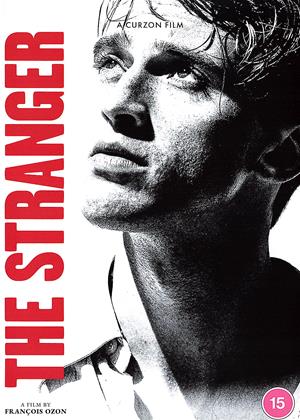

Camus came into my life via the Manic Street Preachers, who quoted and referenced him so often I felt impelled to read his work. So I was oddly excited to see François Ozon tackle The Stranger. It certainly looks the part: gorgeous black-and-white, hard sunlight bouncing off white walls, shadows doing a lot of heavy lifting. Manu Dacosse’s camera gives Algiers a crisp, slightly unreal shimmer that suits Meursault’s detachment.
Benjamin Voisin makes Meursault more magnetic than blank, a man who feels things and simply refuses to perform them. It’s an interesting choice, even if it softens the shock of the character. Rebecca Marder brings real warmth and hurt to Marie, while Denis Lavant and Swann Arlaud add familiar Ozon flavour around the edges – half grotesque, half sympathetic.
The snag is the shift away from the novel’s first-person narrative. By dropping that tight POV, Ozon loses a lot of the book’s unnerving interiority, then tries to win it back by spelling out subtext in dialogue. The absurdism and existential shrug are still there, but you have to dig for them while the film underlines points Camus left hanging.
There’s plenty to admire – the oppressive heat, the courtroom circus, the slow slide towards catastrophe – but the post-colonial tweaks don’t add much, given Camus was already skewering the set-up. And slapping The Cure’s “Killing an Arab” over the credits feels crass and out of step with the film, like a knowing meme where a real idea should be.
Camus’ L’Etranger is not an easy book to adapt. Luchino Visconti tried in 1967, but failed to capture the novel’s sense of solitude and abandon. François Ozon’s new adaptation is far better. Firstly, he successfully transforms Camus’ words into pictures - in this case, high-contrast black-and-white images that convey the author’s eye for immersive detail, plunging us into a Mediterranean world of sea, sex and sun that’s enchanting until it becomes unbearable. Secondly, Ozon diverges from the text in a few key places to offer a postcolonial reading of a novel that was published two decades before Algeria liberated itself from French rule. In Camus’ book, the viewpoint of the Arab characters is altogether absent, whereas here Ozon has chosen to give Algerians more of a voice, albeit in a subtle fashion, commenting on the indifference of Frenchmen toward a situation that would soon give way to violent revolution. Purists may take issue with this, but the director deserves credit for finding an intelligent way to update the book for a generation that has come to reject colonialism both past and present.
Ozon’s film is a pleasure to watch both aesthetically and dramatically, a feast of sights, sounds and existential turmoil. After an opening newsreel proves how disparagingly the French looked upon Algerians at the time, we find Meursault (Benjamin Voisin – superb throughout, effectively carrying the entire drama as a lost soul whose physical attractiveness does not conceal the emptiness inside him) alone in his apartment when he learns about the death of his mother. Withdrawn and taciturn (he hardly speaks, and when he does it’s often to say, “Je ne sais pas”) he heads to the countryside to hold vigil over his mother’s body. Ozon conveys the loneliness of Meursault, not to mention the desolation of the people he encounters, through striking shots that frame them against barren landscapes or interiors. When Meursault returns to Algiers after the funeral, the film shifts tones to showcase the sun-baked beauty of a colonial capital at the height of its splendour, while occasionally cutting away to reveal an Arab population treated like second-class citizens. During a visit to the seaside, Meursault bumps into an old friend, Marie (the excellent Rebecca Marder). Although he’s supposed to be mourning his mother’s demise, he quickly embarks on an affair that, at least from his point of view, is much more about carnal satisfaction than love. Meursault also starts hanging out with his shady French neighbour, Raymond, whose abusive relationship with an Algerian woman eventually leads to the murder.
Camus’ book is split evenly before and after the killing, whereas the film spends more time chronicling Meursault’s life up to the point he’s arrested. Some of the best scenes highlight the deep despair of that life, emphasising how Meursault is indeed a stranger (or more accurately outsider, as the title of the book was first translated to in English) in a land under occupation. Ozon implies that Meursault’s alienation also stems from the oppression he’s perpetuating, whether consciously or not, in a country soon to be embroiled in a bloody war of independence. The last act focuses on his imprisonment, trial and the weeks leading up to his execution, including a tense conversation with a priest hoping to read the inmate his last rites. Just as in the book, we understand that Meursault is condemned to death not only because of his act, but because of his failure to display ‘normal’ human emotions, whether about the crime he committed or his recently dead mother.
Perhaps the film’s greatest invention is to also give a name to the nameless “Arab” whom Meursault kills. Camus’ formidable antihero may be lost to his own demons, as well as to the demons of colonialism, but Ozon boldly suggests that the memory of his victim may live on as a harbinger of what is to come. Powerful stuff.
I have not read this novel - I did try a couple of others by Camus when younger, but gave up. They, like many French films, are dripping with philosophical wisdom and existentialism - I may try to read L’Etranger now as an older reader.
Anyway, I really liked this film. The cinematography is perfectly monochrome, which paradoxically makes the dripping heat and humidity of sun-drenched Algeria even more real (watch the DVD extras to learn from director and stars' interviews that it was filmed in Spring, so not so hot, and filming in colour would have shown north Africa as cooler!). Perfect for the courtroom and prison cell shots too, all those German expressionist shadows a la Nosferatu and M.
I have not watched other versions of this novel so cannot compare. All I can say is that the actors are perfectly cast, with Benjamin Voisin perhaps too prettily magnetic for a role meant to represent a blank man unmoved by existential forces - and it is very VERY French on the philosophy as one would expect. Voisin is like the Alain Delon of now - watch his interview in the extras on the DVD. The character here is SO philosophically French, all casual shrugs, that at times I was almost yelling at him on the screen stuff like LISTEN TO YOUR LAWYER and JUST SAY WHAT YOUR LAWYER TELLS YOU TO SAY! (no spoilers). or even SAY YOUR THOUGHT THE ARAB WAS GONNA GO FOR YOU WITH THE KNIFE. But no, that's be far to pragmatically British LOL!
Some may be confused by time shifts and ambiguity of dreams/reality so do not look away or lose concentration - but for me, it was a mesmerising experience. I am unsure if the novel concludes things more solidly but do know it has a close first person point of view. Perhaps the story loses its power a bit by the director here using multiple points of view? I'd also say there could be pointers on screen as to the date - which is 1938/9 as the DVD extra interviews reveal.
AND I was not a fan of the glib using of The Cure's Killing an Arab over the end credits, despite knowing the song and having watched the band like at Glastonbury many moons ago. It jarred badly IMHO with the overall feel of the film.
Do watch the DVD extras, two early 1990s short films by the director and illuminating interviews with the director and the two main stars including Voisin.
Also, for those who want to know more about the French-Algerian relationship, watch DAYS OF GLORY (2006) a great French film about north African Arabs/natives and the 'Pieds-Noirs', white French of European descent who were born in Algeria during the period of France colonial rule from 1830 to 1962. Most departed for mainland France during and after the Algerian War of Independence). Britain GAVE up its empire; France did not - it fought for it, causing the Viet Nam war in French Indo-China and that Algerian War.
One line in the film made me laugh. The dead Arab's sister says his killer should 'go home' so the hero's girlfriend says 'this is his home' at which the Arab sister laughs. Hmmm I wonder if you told all the north African heritage folk in France to go home (to Algeria etc) what you'd get called. BUT this does raise issues of nationhood, loyalty etc.
Watch THE BATTLE OF ALGIERS (1966) and often cited amongst the best films ever made anywhere to see the later events that happened post WWII in Algeria.
Not perfect, but I was enthralled, so 4 stars.
