Rent I Swear (2025)
4.2 of 5 from 183 ratings
1h 55min

I was at school when the BBC showed John’s Not Mad, and the next day the playground was suddenly full of kids “with Tourette’s” — mainly because it sounded like a free swear pass. So I wasn’t exactly excited for I Swear. I expected a nice-but-soggy tearjerker.
But Kirk Jones’ 2025 biopic is better than that. It keeps things grounded and lets the awkward stuff sit there: the staring, the misunderstandings, the way it creeps into family life. It does press the “you should be moved now” button once or twice, but it avoids turning into a syrupy lecture.
The acting is what sold me. Robert Aramayo gives John proper bite as well as vulnerability, and Maxine Peake is great — warm, tough, and believable without being turned into a saint. It’s not perfect, but it’s genuinely affecting, and it earns that the hard way.
Based on a true story this is a very moving drama about John Davidson who as a young teenager developed Tourette's Syndrome alienating him from his peers, drove his father from the family home and resulted in bullying, assault and occasionally arrest by the police. It's wonderfully scripted and has a touching and sentimental lead performance from Robert Aramayo as the adult John. The drama follows his difficult family life as his mother finds it hard to cope and how his old school friend's mum, Dottie (Maxine Peake), a trained mental health nurse decides to help him. Peter Mullan plays the local community centre caretaker who gives him a job and wisely suggests it's education of others that is needed about the condition. This eventually leads John to start talks with parents of children with Tourette's, the police, hospital staff which results in national recognition. This story is told in a quite emotional way, with laughs and shocks along the way. Scott Ellis Watson also excels as the young John who as a young boy has to deal with the onset of the condition. As a film about someone dealing with a mental health condition that is little understood this is remarkably good and told with a gentle, yet uncompromising focus on the issue.
For many people in the UK, they will recognise John Davidson, if not from the documentaries he was featured in, then from the appearances in other media due to his Tourettes syndrome condition. Characterised by motor & verbal tics, shouting, swearing and other actions completely out of their control, it is for many an unbearable existence. And added to that, the tension after-product simply exacerbates everything. It is a Catch-22 condition in every sense of the word. And as we follow the story of John, from his childhood in the early 80's through to the present day, we see just how much the misunderstanding & ignorance of the condition affected not only him, but the others around him.
We first meet John as a teenager starting his new school in Scotland. He is popular, boisterous & a talented goalkeeper, with a bright future ahead of him. Then slowly, a myriad of tics, swearing & spitting of food start to make his mere existence unbearable. In early 80's Scotland, this results in endless punishments, ostracisation & ridicule from everyone. His family life is destroyed, due to the tension & anger generated by his outbursts.
Once he leaves school with no qualifications (forbidden from taking his exams,) he has few options, living with his mother who is at her wits end. Then he meets Dottie, the gentle & kind ex-mental health nurse and mother of his friend. She takes him in and gives him a new lease of life, along with a hope for a better future.
What this film emphatically is not is a saccharin sweet, syrupy tearjerker where John's tics are used as a way to leverage emotion from the audience. Never for 1 second is John mocked, but also neither is it forbidden to laugh with him at some of the funny things he says. The writers have wisely realised that if this film had no humour to balance out the unbearableness of John's life, this would be an almost impossible watch.
What this film does so well is to show that, despite the numerous setbacks John has to deal with, including vicious attacks & arrests, when he is given the proper support, he thrives. From when he starts work at the community centre, giving him a reason to get up in the morning, through to fulfilling the promise he made to a mentor to spread understanding of Tourettes, these are his hard-won achievements.
The emotional journey that you are taken on is also profoundly affecting. Many times, tears started streaming down my face, as the pain or the pride you are witnessing impacts you to your bones. Moments in hospital, a reconciliation & testing experimental treatments all absolutely floored me.
In terms of acting, we are in the absolute peak of British talent. Scott Ellis Watson & Robert Aramayo are incredible as the young & present day John. There is so much care in how they portray him, to the extent that Aramayo lived with him for a time to be able to fully realise his portrayal. Maxine Peake & Peter Mullan do some of their best work as Dottie & Tommy (the manager of the community centre,) and special mention must go to Shirley Henderson, again doing so much with limited screen time.
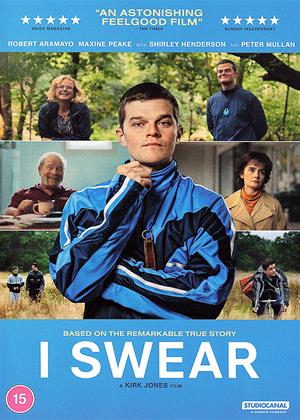
On the poster for this film, one of the quotes was "This film could change someone's life." That statement is wrong... This film WILL change not only one, but many people's lives, not only sufferers of Tourettes but their families & those within education, health & law enforcement. It is a starter gun for what I hope is serious change of how this condition is seen, as well as turbocharging research into it being able to be managed better.
And finally to John, thank you for sharing your life story, allowing us to see your experiences growing up as well as your determination to ensure that the future for Tourettes suffers today will be more accepting than the hell you managed to survive. You are an inspiration
