Rent The Long Walk (2025)
3.3 of 5 from 219 ratings
1h 44min
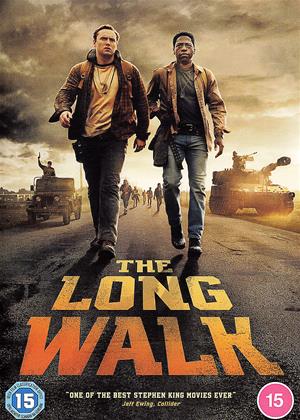

Picture the setup: near-fascist America turns adolescent misery into primetime entertainment, and the only rule is keep walking. Not a metaphor, not a motivational slogan — a commandment. The really creepy bit is that Stephen King cooked the idea up at university in the late ’60s, and here we are, decades later, treating it like a handy bit of fiction rather than a public service announcement.
But the film’s been marketed to death. The trailer doesn’t tease; it summarises. So the first stretch can’t build much dread, because you already know the route. Once the premise is established, the middle portion starts to repeat itself: warning, stumble, calculation, cruelty, rinse, repeat. That might be the point — systems are monotonous, brutality is boring — but cinema still needs rhythm, not just mechanism.
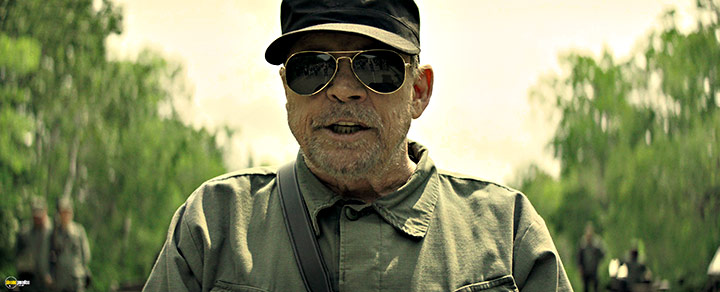
There are compensations. David Jonsson walks in with real screen electricity — the sort you can’t fake, the sort casting directors go feral for. Cooper Hoffman… I’m less sold. He’s fine, but he doesn’t quite anchor the thing the way it needs. Still, the friendship does register, which matters, because without that human thread it’s just a treadmill with bullets. And yes, Mark Hamill turns up, and if you don’t spot him straight away you’ll feel mildly foolish.I did.
The ending arrives and… sort of sits down. It isn’t outrageously bad, it’s just dutiful. Yet any “satisfying” alternative would be a cheat. This is a story about a machine. Machines don’t do catharsis. They do output.
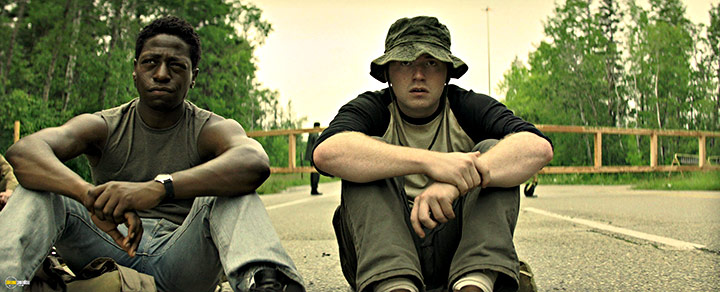
Every year, in a horrendously dystopian future America, 50 young men "volunteer" to compete in "The Long Walk." The rules are simple: you walk, keeping a constant speed of 3MPH; if you slow down you are given 3 warnings, and if you do not pick up your speed within that time, you are shot. There is no finish line and the winner is literally the last man standing. The victor is given 1 wish, alongside all the money in the world. In the ugly cesspit that this alternate America has become, it is the unmissable event of the year. Into that walks Garraty, who has a vendetta against the Major, the demonic overseer of the walk. He quickly forms a bond with McVries, an eternal optimist who has had his own difficult journey to this point.
I had seen a few of Stephen King's film adaptations (The Shining being the one which most profoundly disturbed me.) After watching Misery and being captivated by Kathy Bates's performance, I added The Long Walk to my list. But my main reason for wanting to watch it was David Jonsson. He has, in little over a year, become one of my favourite actors. Between this, Alien: Romulus and Wasteman, there is literally nothing he can't do. His presence and magnetism is exceptional and, when paired with Cooper Hoffman, who was brilliant in Licorice Pizza, they make for an incredible double act. There are a few other recognisable faces, such as Mark Hamill and Roman Griffin Davis, but Hoffman and especially Jonsson are the only ones you'll remember.
The film is well-shot by Francis Lawrence, who is a veteran director and an unquestionably safe pair of hands for this sort of moderately-budgeted adaptation. Another notable thing about this film (which was amusingly revealed on the behind the scenes feature,) was King's insistence, which went as far as being mandated in a contractual agreement, that this was in no way a toned down movie. It is a brutal unforgiving watch, with multiple close-up scenes of men who are just out of adolescence being coldly executed when they literally cannot walk any further/mentally break-down.
But despite the central idea being not only a good one, but a powerful allegory against war/conscription (King wrote it due to his disgust with the Vietnam war,) once the different players are introduced and the walk starts, the limits of the screenplay/thematic adaptation start to show. There are unquestionably powerful individual moments which stick with you and make an impact. But there is also a large amount of time when there is stilted & uninteresting dialogue and what feels like padding to try and stretch out this good idea.
And then as the film goes towards it's ending, as much as it does have a couple of surprises up it's sleeve, it is too little too late. And then we get to the ending and that is literally what happens: the film just randomly ends. It is one of the most rushed finales I have seen for quite a while and really seems like the writer pulled the plug because he wasn't sure what else to do (I say that having not read the book, so it may be that that is how the novel ends, but it doesn't change the fact it's a crap ending...)
There is plenty to enjoy with Hoffman and Jonsson's chemistry, and I am sure that die-hard King fans will love it. But apart from the two performances, there isn't that much to recommend it
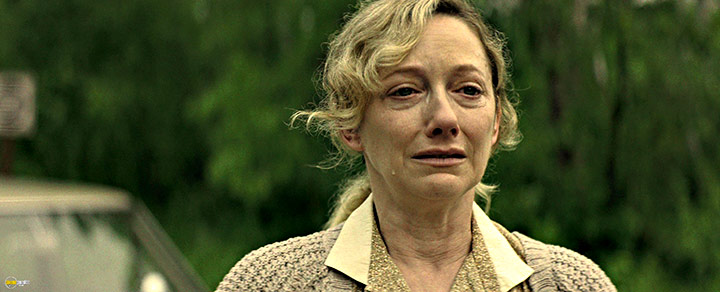
Adapted from an early Stephen King novel this is a film that falls into the dystopian cycle of films where a future society devises some game or contest where it's win or die and designed to benefit society in some warped way; films such as Battle Royale (2000), The Hunger Games series, The Purge series or The Running Man (1987 & 2025) for example. Here in a collapsed USA, after some big war, society is in lethargy and the military control a televised contest where 50 teenage boys are selected by ballot to endure the Long Walk. Fall behind, break any of the rules or even slow down and you get shot until the last man standing wins riches beyond his dreams. This is meant to inspire people! The narrative is one that has to focus on the conversations between the contestants as they reveal their motives for competing and their various issues in the depressed lives they all lead. The deaths are often bloody and shocking but ultimately it's a film involving a lot of walking and talking. It's interesting enough highlighted by the presence of Mark Hamill as the nasty military man and Judy Greer as a worried mother of the main character played by Cooper Hoffman. It's ok but all feels a little too contrived and the ending seems both predictable in one way, surprising in another and ultimately a little disappointing.