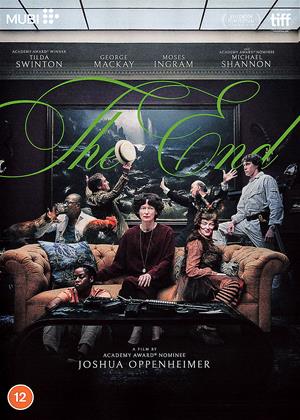
Self Indulgence from the Usually Reliable Joshua Oppenheimer
- The End review by griggs
The End tries hard to be profound but ends up lost in its own seriousness. It’s beautifully shot and has moments that nearly work, but they’re buried under layers of self-indulgence. There’s a great film somewhere, but it never entirely breaks through.
1 out of 1 members found this review helpful.
Cringe-making
- The End review by Alphaville
An achingly overlong drama that plays like a student film gone wrong. In an underground bunker, a family stand around and sit around talking, talking, talking. Some of the dialogue is actually sung for no reason whatsoever. The DVD blurb promises ‘inspired vision’ and ‘soaring music’. Er, no. With apologies to all the actors roped in to this, if you have any feeling for film you’ll soon be reaching for the eject button.
0 out of 0 members found this review helpful.
Post-apocalyptic drama strikes wrong note
- The End review by PD
Joshua Oppenheimer’s distinctly original musical drama is set in a fossil-fuel oligarch’s luxury survival bunker in a desolate salt mine. “The houses are all gone under the sea,” begins the T.S. Eliot quote that opens the film. “The dancers are all gone under the hill.”
Mother (Tilda Swinton – inevitably superb throughout) was once a ballerina, whom Father (Michael Shannon) and Son (George MacKay – also very impressive) routinely praise for having performed at the Bolshoi many years ago. It seems to have been 25 years since they retreated underground; in fact, 20-year-old Son has only ever known the painstakingly-decorated bunker, filled with artistic masterpieces.
Mackay’s character is one of naive brilliance, someone who commemorates major historical moments through their inclusion in a remarkable diorama which includes Chinese workers with smiling faces, and who assists his father with his self-serving autobiography that no one will read – a work in which of course he absolves himself of any blame for the climate crisis. Mackay is in many ways the most interesting person on show with many of the best lines, whilst Swinton’s character speaks volumes mainly by expressions and countless evasions. The rest of the household consists of Doctor, whose main medical task seems to be prescribing sleeping aids for everyone’s incessant nightmares; agreeable Butler, who tends to Father’s demands, and Friend, who’s specified to be Mother’s closest companion and the only loved one who was allowed in the bunker when the end times first unfolded. Interestingly, the only names ever uttered are those of relatives who were abandoned. Son gently speaks the name of his mother’s sister—which he only discovered by snooping through an old tablet—and Friend continues to profess love for her child who supposedly died before the apocalypse.
There’s very little ‘action’ as such, and the 148-minute runtime feels distinctly overlong by at least half an hour. The only major plot development occurs when a ‘stranger’ (Moses Ingram) somehow manages to make her way in the mine with the inevitable conflicting consequences - the rest of the tribe debating fiercely over whether she should be allowed to stay. While the outsider’s presence begins to poke holes in the group’s collective fallacy, it’s also clear that ugly grudges and harsh truths were always at risk of breaking through, much like the cracks that consistently appear on the bunker’s walls, and much of the film is spent giving us glimpses into the various individuals' respective pasts and thus different forms of guilt.
However, for all the intriguing premise and impressive performances, ultimately the film fails for me. Apart from the length, the film rather shies away from direct confrontation of the actions and individuals responsible for our climate crisis: the terrible but all-too plausible scenario of elite survivors of apocalypse prioritising the preservation of mostly Western “masterpieces” and their own reputations never blooms into fuller consequences. But the film’s major downfall, is that its musical numbers are dull, discordant and downright intrusive. Despite its stage-influenced production design and a single fleeting tap-dance sequence, the lyrics penned by Oppenheimer and music by Joshua Schmidt simply don’t capture the songwriting finesse of the Golden Age they are presumably so desperate to emulate. You can see what Oppenheimer is trying to do - individual traumas exorcised in order to maintain a utopian illusion—but their harmonised phrases only serve to convey far more about the fantasy they’re forced to project. As another reviewer said, there's a good film in here somewhere, but all in all, rather disappointing.
0 out of 0 members found this review helpful.