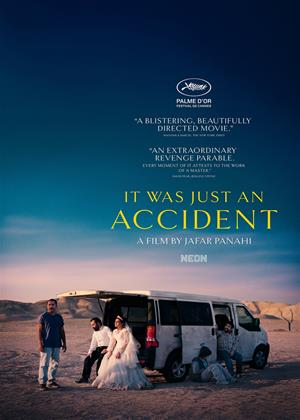
It Was Just an Accident (2025)
- General info
- Available formats
- Synopsis:
A man, nicknamed Eghbal (Ebrahim Azizi), is driving at night with his wife and daughter when he hits and kills a dog. The accident badly damages his engine and causes the car to later break down. He pulls over to a nearby garage, encountering a former political prisoner named Vahid (Vahid Mobasseri), who recognizes the squeaking sound of Eghbal's false leg as that of an intelligence officer who tortured him in prison and caused him permanent kidney damage. Vahid stalks Eghbal to his house, kidnaps him, and prepares to bury him alive, but grows doubtful about the man's identity since he was blindfolded and had never seen his torturer's face. He reaches out to a fellow ex-prisoner for confirmation, and meets up with the bookseller Salar, wedding photographer Shiva (Mariam Afshari), bride Goli (Hadis Pakbaten), groom Ali (Majid Panahi), and angry worker Hamid (Mohamad Ali Elyasmehr). Riding around day and night, Vahid's van is occupied by these victims all seeking revenge on the man who brutally abused them. During their ride, they contemplate the morality of killing their captive and whether he actually is who they believe him to be. - Actors:
- Vahid Mobasseri, Mariam Afshari, Ebrahim Azizi, Hadis Pakbaten, Majid Panahi, Mohamad Ali Elyasmehr, Delmaz Najafi, Afssaneh Najmabadi, George Hashemzadeh
- Directors:
- Jafar Panahi
- Producers:
- Philippe Martin, Jafar Panahi
- Writers:
- Jafar Panahi
- Others:
- Shadmehr Rastin, Nader Saïvar, Mehdi Mahmoudian
- Aka:
- Det var bara en olycka
- Genres:
- Action & Adventure, Drama, Thrillers
- Collections:
- Award Winners, Oscar Nominations Competition 2026
- Countries:
- Iran
More like It Was Just an Accident

Reviews (2) of It Was Just an Accident
The Sound of a Creaking Conscience - It Was Just an Accident review by griggs
Jafar Panahi’s It Was Just an Accident begins with a bump in the road — literally. A man hits a dog on a dark Iranian highway, and from that small mistake spirals a chain of guilt, corruption, and quiet fury. What starts as a roadside mishap turns into a grotesque moral farce: bribes tapped on card readers, weddings collapsing, and the long shadow of state violence falling over every polite exchange.
Panahi directs with the poise of a man long practised at evading censors — sly, unflinching, and darkly amused by power’s absurd theatre. His characters drift between tragedy and farce, like citizens rehearsing the same lie for different audiences.
It Was Just an Accident is mordant, chaotic, and painfully human — a parable of control and complicity disguised as chance. In Panahi’s Iran, even the accidents feel designed.
Impressive seriocomic morality tale - It Was Just an Accident review by PD
Jafar Panahi’s latest is another reflection of his currently fractious relationship with his country; as with all of his work, it's astutely aware of the physical and psychological scars that result from living in a state of tyranny.
The film begins ominously with a family driving down a dark road, the headlights of their car providing the only illumination. Suddenly, the vehicle hits and kills a stray dog, which immediately distresses the young girl in the backseat. Her expectant mother, attempting to calm the child down, explains that this unfortunate occurrence must all be part of God’s plan. “God had nothing to do with it,” the girl responds, pointedly countering her mother’s naïve optimism, while her father remains stoic behind the wheel. Indeed, this accident will have devastating ripple effects, and to the point that the question of God’s involvement will be the least of anybody’s concerns.
The film reveals itself as a seriocomic morality play, with the characters’ contrasting points of view vividly illuminated by how their varying temperaments ricochet off of each other. In a notable scene, Panahi keeps his characters in a state of queasy tension after they catch the attention of security guards at a parking garage. The guards ask for a bribe to look the other way, and when they say they don’t have any cash, the guards quickly produce portable card readers. The film aims a satiric arrow at the corruption that’s rampant in Iran by making the characters’ overarching fear of being caught with a kidnapped person an ultimately baseless one in a world where nothing matters except for personal gain. Ultimately, Panahi is interested in exploring how life under tyranny turns everyone into the worst versions of themselves. This isn’t to say that Panahi’s anti-authoritarian spirit doesn’t flow through the film, as evidenced by his deliberate decision to not have his female characters wear hijabs, in defiance of Iran’s strict religious rules. And the film's final moments bring Panahi’s critique of contemporary Iran into especially grim focus, as an ostensibly happy conclusion morphs into existential dread with the realisation that no matter what the oppressed do to move past the trauma of what they’ve experienced, it will always be one triggering thought, or sound, away. By now, the Iranian regime’s victims far outnumber its oppressors, whose draconian measures are inadvertently creating the very resistance they’re trying to suppress. When things eventually reach a tipping point, Panahi wonders whether the citizens’ revenge should be correspondingly cruel, or if they should show mercy? It’s telling that Panahi is no longer obliquely challenging specific policies but openly threatening his overlords with payback. Impressive stuff as always from a great director.