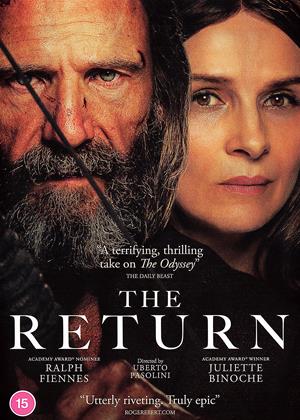
Homecoming Without the Mythology
- The Return review by griggs
Everyone’s gearing up for Nolan to take a swing at Homer, but this gets in first — and keeps its feet on the ground. No Cyclops, no sirens, no mythological fireworks. It’s more interested in what happens after the fighting stops, when you still have to live with yourself.
Odysseus washes up on Ithaca alive but clearly not okay, and the film sits with the hangover of survival: shock, grief, and the quiet shame that comes with making it home. Ralph Fiennes plays him like a man who’d rather stay unrecognised — guarded eyes, hunched shoulders, a body that looks like it’s still bracing for impact. Juliette Binoche holds the centre as Penelope, quietly refusing to be pushed into remarriage while the suitors loiter and the household frays.
I liked the stripped-back, no-myths approach, and the two leads do most of the heavy lifting. But once the setup is established, the film loses momentum. Some supporting strands feel thin, the editing is oddly choppy, and I ended up admiring the restraint more than feeling the ache. Worth seeing for Fiennes and Binoche — just not the gut-punch it’s aiming for.
2 out of 2 members found this review helpful.
Painful
- The Return review by Alphaville
Slow, deliberate, downbeat talkathon about Odysseus’ return from the siege of Troy to his home island of Ithaca. Director Paoslini’s deadening hand gives his actors no chance as they enunciate their lines to camera with laughably intense import. Ralph Fiennes has to emote, Juliette Binoche has to sulk. None of it is believable while the plot (such as it is) trundles along with endless court rivalries about who shall be the next king.
It’s more like a BBC heritage drama than a big-screen feature film (‘I Claudius‘ was far superior). According to the DVD Extras, Pasolini had been trying to get the script written for 30 years and the angle he chose to highlight was family dynamics. Yep, you heard right. No wonder it took so long to get the green light. One of the great sagas of ancient history reduced to the level of a stagey and inconsequential soap opera.
1 out of 3 members found this review helpful.
Rather slow
- The Return review by SB
For most of the film, Odysseus was deliberately going incognito, and was repeatedly scorned and abused as a nobody or a tramp. This was tiresome and did not make for a compelling film. Once he revealed and proved his identity, the film became more lively and interesting. But, by then, it was a bit too late for me - hence only 3 stars.
1 out of 1 members found this review helpful.
Powerful Drama
- The Return review by GI
Despite its slow burn pacing this is a riveting drama studying PTSD, survivor guilt, relationship abandonment and lost love. It's an adaptation of the final passages of Homer's Odyssey where Odysseus finally returns home after 20 years absence. Played with unbeaten, sinewy energy by Ralph Fiennes, Odysseus is washed up on his island home and taken in by a humble pig farmer. He keeps his identity secret not knowing how he will be received nor what has happened in his absence. He gradually finds that his wife, Penelope (Juliette Binoche), has shunned a host of suitors who hang around his castle awaiting her to choose one of them. His now grown son who he has never met, Telemachus (Charlie Plummer) is suffering with his life and urges his mother to take a new husband. But over the course of the film Odysseus' true identity becomes known and he tries to understand if to or even how to take up his former role as ruler of his island home and can he rekindle his marriage and gain the love and respect of his son. This plays out like a Shakespearean tragedy, violent, emotional and enigmatic it's a fierce drama full of restrained energy and I really enjoyed it.
0 out of 1 members found this review helpful.
Slowbeat, Stagey & Wordy, this is an Italian Film Really All About Coming Home
- The Return review by PV
Slowbeat says it all. I stuck with it, enjoyed the beautiful Greek island scenery and was interested to read in the end credits that some of it was filmed at Ostia Antica, the former Roman port (now 2 miles inland) half an hour by train from Rome. Great place to visit, more compact than Pompeii.
Definitely not a film for kids of those lacking patience - put on the subline JASON AND THE ARGONAUTS (1963) or a SINBAD film for that.
I did enjoy it, with reservations. All a bit soapy for me, family relationships. Reminded me a bit of TV drama VIKINGS and Ragnar's journey. probably a good add-on film to the major big budget Odyssey movie.
The latter's caused controversy by casting a black woman as Helen of Troy (absurd for an age that valued very white fair blonde blue-eyes girls most of all), and this also parachuted those with sub-Saharan African features into this Ithaca, an island to the west of Greece near Corfu. WOULD there be so many black African-origin faces there 3000 years ago? No. Maybe the odd one. For those who defend this colourblind casting, fine, but be consistent - so let's see black Chinese emperors and Indian sultans then, and white ones, and maybe white ginger Zulu warriors and Chinese ones, with ed Sheeran playing Nelson Mandela and Lenny Henry and Idris Elba playing Samurai. OK? I hate this colourblind casting cult, makes me wince ESPECIALLY as the baddie is, yep, you guessed it, a very Nordic white blond man. Sigh...
The director seems to make very stagey films, which perhaps should be drama-documentaries on BBC2 or Channel 4. I half expect some TV presenter in a sunhat to pop up between scenes explaining the historical context, arms flailing as they do that slow walk to camera they learnt at TV presenter college...
to me, it felt like an Italian film - I see it's a UK/France/Greece/Italy coproduction but most cast and crew are Italian, from the names.
I enjoyed the climax. But even I, with my well-trained attention-span, found the prelude wearing at times... and I do confess to clock-watching! The third act is great though.
3 stars.
0 out of 0 members found this review helpful.
Slow moving drama
- The Return review by CD
Very disappointed in this film given the quality of the cast and the epic story of Odysseus. While the imagining of the palace and the suitors piques the interest early on, the slow dramatic presentation sucks the life out of the action. One is left scarcely caring how it ends given that Odysseus seems content to stay a beggar for most of the film. It needed a spark in the story and dialogue which for me never came.
0 out of 0 members found this review helpful.