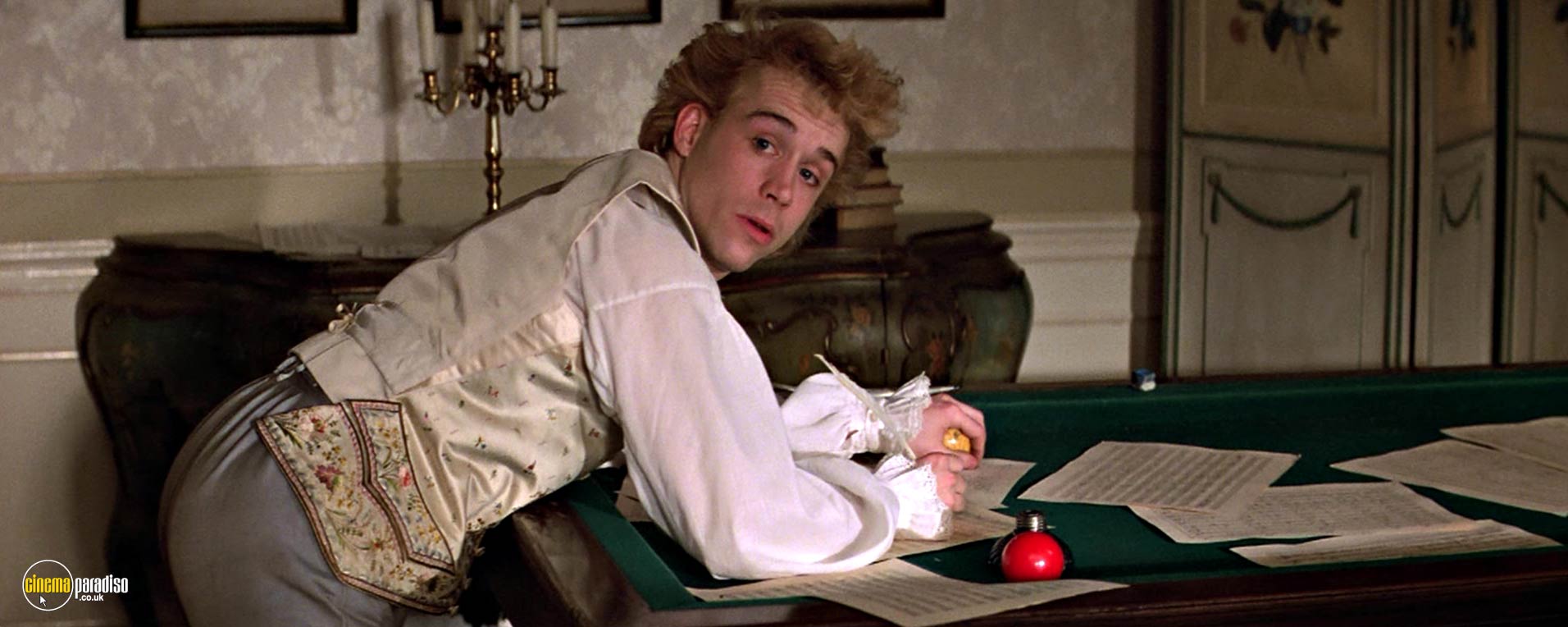
With a 4K restoration of the multi-Oscar-winning Amadeus (1984) tuning up in preparation for a cinema release, Cinema Paradiso follows up its survey of composers by focusing on musicians in the second part of its Brief History of Classical Music on Film.
Although many critics compared Emmanuel Courcol's The Marching Band to Mark Herman's Brassed Off (1986) because it featured a brass band in an economically deprived area, the protagonist is actually a classical conductor with a penchant for jazz. Thibaut Desormeaux (Benjamin Lavernhe) is one of the world's leading conductors and he is rehearsing an orchestra for a prestigious concert in Paris when he collapses on the podium. Diagnosed with leukaemia, Thibault asks his sister to donate bone marrow, only to learn that he was adopted and that he has a younger brother in a small industrial town near Lille.
Resentful at having been discarded by Thibault's adoptive mother, school cook Jimmy Lecocq (Pierre Lottin) is initially reluctant to help. But he agrees to undergo match tests and quickly discovers that he has music in common with his sibling, as Jimmy plays trombone in the local marching band. Moreover, they share a love of jazz and, when the band's conductor gets a new job, Thibault agrees to pick up the baton as a way of thanking his newly discovered brother.
Fraternal and socio-cultural complications ensue, much as they did in Courcol's The Big Hit (2020), in which a struggling actor (Kad Merad) finds himself directing a prison drama group's production of Waiting For Godot. But, while it has its formulaic moments, The Marching Band has plenty to say about human nature, class expectation, the rights of children, and musical taste. In addition to pieces by Mozart, Mendelssohn, Debussy, and Verdi, the score also includes an unforgettable sequence involving Maurice Ravel's Bolero.
British audiences haven't always taken to films about classical music, as they consider them to be intimidatingly highbrow. But The Marching Band is about ordinary people united by a love of music. Indeed, the human factor is invariably as significant as the soundtrack in films about musicians.
Passing the Baton
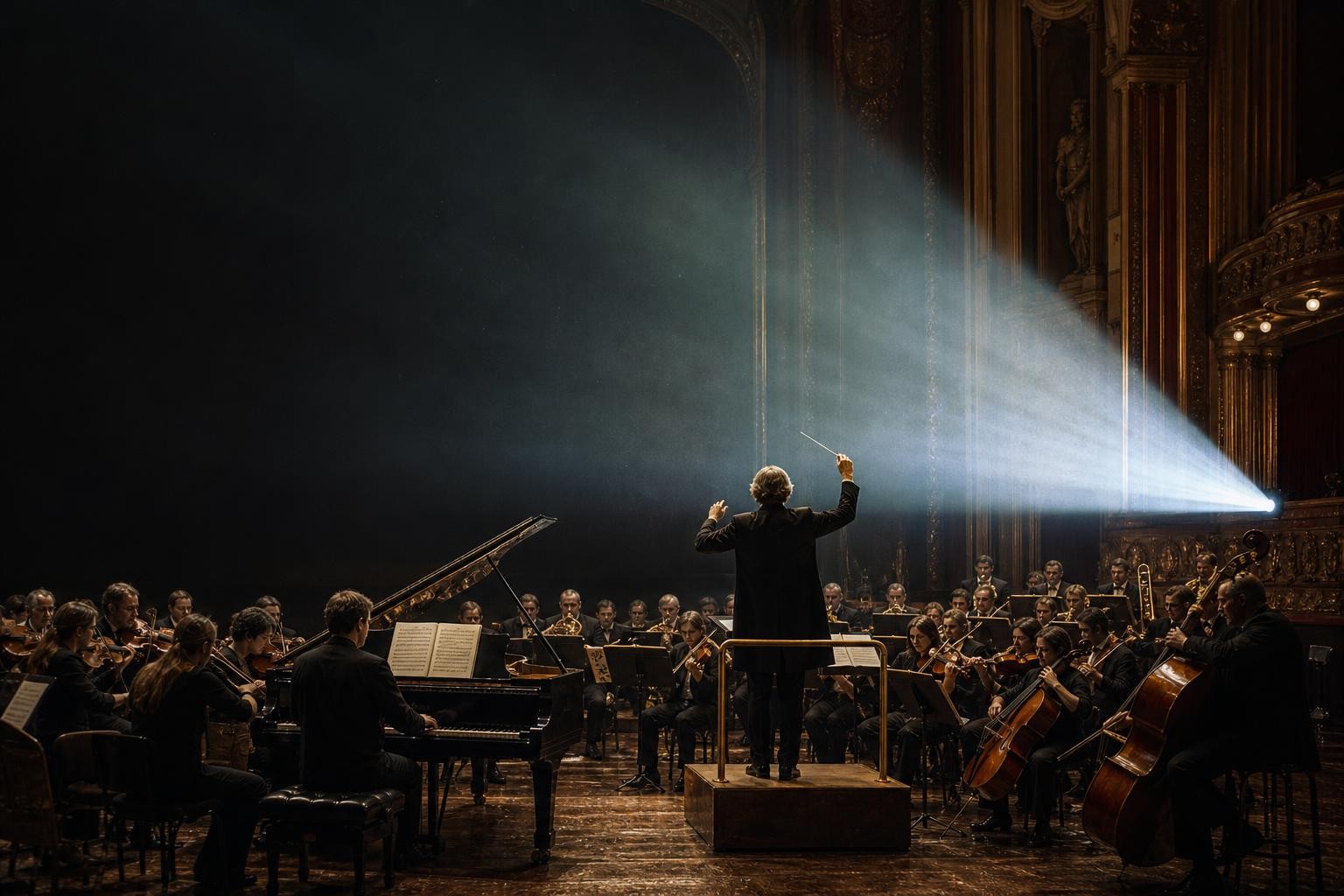
In his 2018 book, The Silent Musician: Why Conducting Matters, British conductor Mark Wigglesworth joked about the stereotypical image of a conductor as a temperamental megalomaniac, who makes no sound while performing 'exaggerated gestures in front of the orchestra, conjuring a cauldron of magical sounds with a kind of wand, and who then accepts the subsequent applause of the audience while - with self-proclaimed modesty - he makes a recognition of the people who have actually played the music'.
Film-makers have played up to this stereotype since the early slapstick days, with
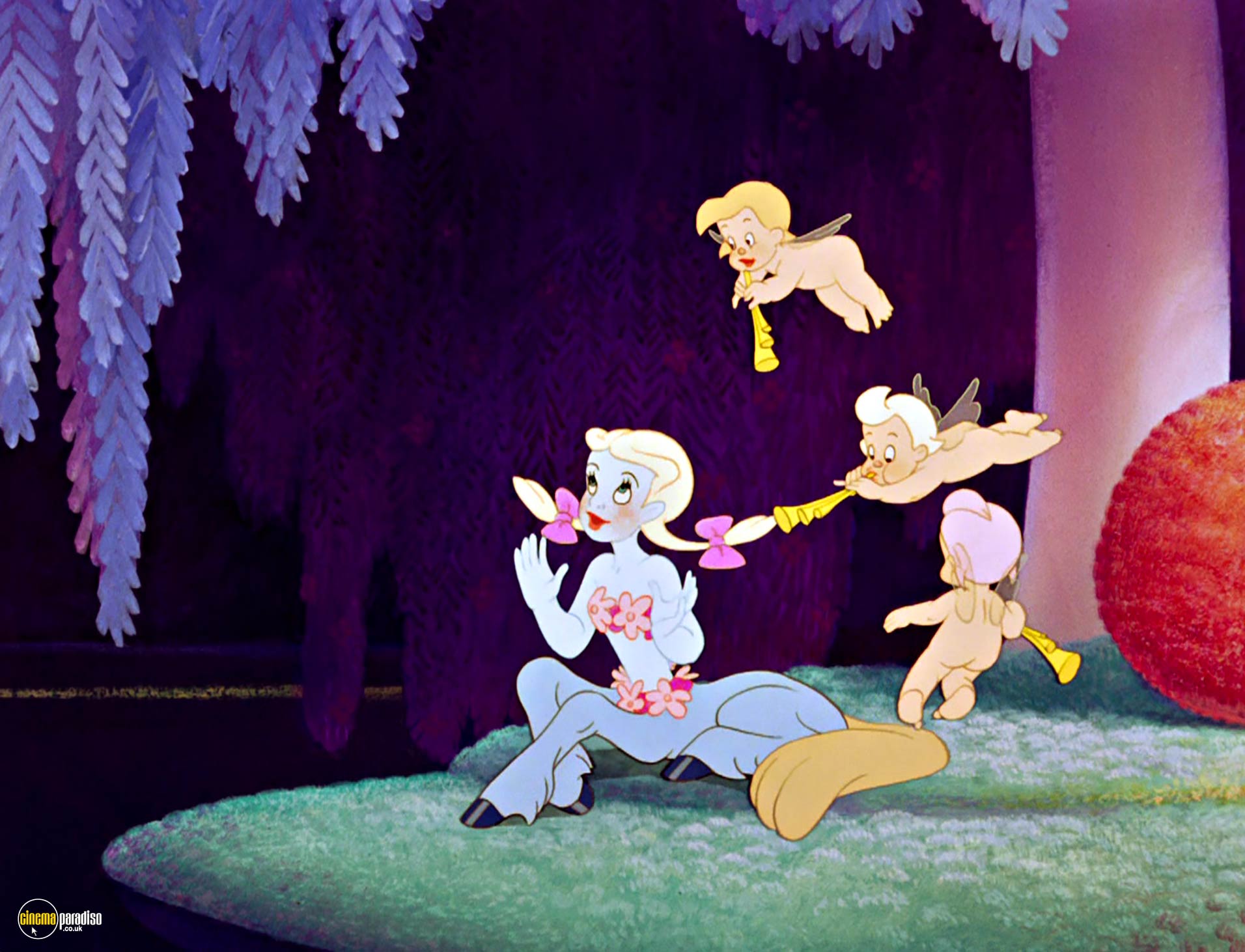
hotel orchestra leader Ford Sterlng flirting with the women in his audience in Edward F. Cline's Hearts and Flowers (1919). However, Walt Disney was aware that the presence of leading conductor Leopold Stokowski was crucial to bringing a little cultural prestige to Fantasia (1940), which featured eight animated interpretations of popular classical pieces performed by the Philadelphia Orchestra. The recording session lasted 42 days and required 33 microphones to capture the magnificence of works by Bach, Dukas, Tchaikovsky, and Stravinsky. The latter also figured along with Beethoven, Shostakovich, Respighi, Gershwin, Saint-Saens, and Elgar, when the Disney studio sought to repeat the formula with Fantasia 2000 (1999).
Stokowski was also among the celebrated conductors and musicians in Edgar G. Ulmer's Carnegie Hall (1947), which also featured violinist Jascha Heifetz and pianist Arthur Rubinstein. But we'll stick with animation to recall how Italian animator Bruno Bozzetto used the music of Debussy, Dvorak, Ravel, Sibelius, and Vivaldi to lampoon Fantasia in Allegro non troppo (1976), which also contained live-action segments involving Maurizio Nichetti, the director of The Icicle Thief (1989) and the co-writer of Rocco Mortelliti's The Vanishing of Pato (2010).
Harking back to the knockabout era, Tom and Jerry found themselves in a concert hall in William Hanna and Joseph Barbera's The Cat Concerto (1947), in which the former's bid to play Liszt's 'Second Hungarian Rhapsody' is disrupted by a pesky intruder in his Steinway. This can be found on Tom and Jerry Classic Collection: Vol.2, while Tom and Jerry Classic Collection: Vol.3 (both 2004) is the place to go for The Hollywood Bowl (1950), in which Tom gets some unwanted help while conducting a symphony at the iconic outdoor venue.
We can't currently bring you Carmen Get It (1962), which sees Tom pose as a violinist in a bid to snare Jerry, who is hiding out with the Metropolitan Opera. Sadly, the same is also true of Bugs Bunny's dalliance with Liszt in Rhapsody Rabbit (1946). But don't despair, the classically themed Long-Haired Hare (1949) and What's Opera Doc? (1957) can be rented on Bugs Bunny (2010) and Looney Tunes: Parodies Collection (2004) respectively.
We return to live-action for Philip Moeller's Break of Hearts (1935), which sees Katharine Hepburn's impoverished composer fall for philandering conductor, Charles Boyer. Robert Taylor plays the conductor who becomes smitten with a girl who hails from Tchaikovsky's hometown in Gregory Ratoff and Laszlo Benedek's Song of Russia (1944). Despite being in love, when war breaks out in June 1941, Susan Peters insists on staying to fight for the Motherland. On a lighter note, a European trip causes trouble for conductor Sir Alfred De Carter (Rex Harrison) in Preston Sturges's Unfaithfully Yours (1948), as a private eye informs him that wife Daphne (Linda Darnell) might have strayed during his absence. Bent on revenge, De Carter (who shares traits with the legendary Sir Thomas Beecham) imagines scenarios inspired by the three works he is currently conducting: Rossini's opera, Semiramide; the prelude to Wagner's Tannhäuser; and Tchaikovsky's tone poem, 'Francesca da Rimini'.
Dudley Moore and Nastassja Kinski took the roles in Howard Zieff's remake, Unfaithfully Yours (1984). Douglas Sirk's Interlude (1957) was also reworked under the same title by Kevin Billington in 1968. The original cast Rossano Brazzi as the conductor rehearsing Brahms's First Symphony in Munich when he falls for American visitor, June Allyson, who is unaware that his wife is living with a mental health condition. Oskar Werner and Barbara Ferris headlined the remake, which reached cinemas eight years after Stanley Donen's splendidly convoluted romcom, Once More, With Feeling! (1960), which sees conductor Yul Brynner have to break off from rehearsing Liszt's symphonic poem, 'The Preludes', in order to marry harpist Kay Kendall, who has discovered that their wedding wasn't legal and wants to get properly hitched and divorced before she ties the knot with doctor Geoffrey Toone.
It's a shame that UK distributors have picked up so few of these entertaining films. But Cinema Paradiso users can enjoy Ralph Nelson's Counterpoint (1967), which follows the efforts of conductor Charlton Heston to save his orchestra when they are captured in wartime Europe and forced to play a farewell concert in a German schloss for music-loving Nazi, Maximilian Schell. A different kind of citadel comes to the fore in Yoshitarô Nomura's The Castle of Sand (1974), as conductor Go Kato finds himself among the suspects as Japanese detectives Tetsuro Tamba and Kensaku Morita seek to discover who bludgeoned an old man to death in a Tokyo rail yard.

Trouble also awaits the German conductor (Balduin Baas) in Federico Fellini's Orchestra Rehearsal (1978), as his mutinous Italian musicians take against his autocratic attitude. When a wrecking crane starts to demolish their studio, however, the orchestra looks to the podium for leadership. This sly political allegory may only run for 72 minutes, but it still showcases Fellini's impish wit and boasts a fine score by the great Nino Rota. One might have hoped that the combination of Polish maestro Andrzej Wajda and John Gielgud might have tempted someone into releasing The Conductor (1979) on disc. But we can't currently bring you this allegorical drama, in which Gielgud's conductor becomes besotted with Krystyna Janda, the provincial violinist whose mother had once been his lover.
Fans of Arturo Toscanini are doubly out of luck, as neither Franco Zeffirelli's Young Toscanini (1988) nor The Art of Conducting - Great Conductors of the Past (1995) is currently available. Toscanini, Stokowski, Wilhelm Furtwängler, Herbert von Karajan, and Sir Thomas Beecham are profiled in the latter, but there's a chance to get to know the likes of Daniel Barenboim, Hermann Scherchen, André Cluytens, and Václav Talich in The Art of Conducting - Legendary Conductors of a Golden Era (1996). Cinema Paradiso also offers dozens of documentaries about and concerts by celebrated conductors. Type the name of your favourites into the Searchline to see what gems can be found among our unrivalled 100,000 titles.
Having pitted Niels Arestrup, Glenn Close, and Kiri Te Kanawa against each other during a production of Tannhäuser in Meeting Venus (1991), Hungarian auteur István Szabó focussed on the denazification hearings involving Wilhelm Furtwängler (Stellan Skarsgård) in the gripping Taking Sides (2001), in which the German conductor is questioned by an American interrogator (Harvey Keitel) about his contested loyalty to the Third Reich.

Long before The Marching Band, Swedish conductor Michael Nyqvist returns to his quiet village in the northern wilds of Norrland and finds himself coaching the local church choir in Kay Pollak's charmer, As It Is in Heaven (2004). By contrast, Aleksei Guskov has to leave Moscow to rescue his career after he is demoted from conductor to cleaner at the famous Bolshoi Theatre. However, he intercepts an invitation for the venue's orchestra to perform in Paris and reunites his old Gypsy and Jewish musicians for an audacious deception in Radu Mihaileanu's Le Concert (2009). Co-starring Mélanie Laurent as a free-spirited violinist, the poignant film was nominated for a Golden Globe and won Césars for its score and sound.
Released the same year, Lisa Langseth's Pure centres on the lie told by the Mozart-obsessed Alicia Vikander to secure a concert hall job. She becomes intimate with married conductor Samuel Fröler, who believes that she is the daughter of an Australian concert pianist who died from cancer. But her real alcoholic mother is very much alive. As is Clara Lago, the girlfriend of conductor Quim Gutierrez who fakes her own disappearance to exact her revenge upon him when he flirts with a pretty violinist. However, he takes up instead with Martina García, who keeps hearing odd noises around the house in Spaniard Andrés Baiz's thriller, The Hidden Face (2011).
When the members of a disbanded Japanese orchestra decide to reform in Kobayashi Shotaro's Maestro! (2015), they struggle to hit a right note. But conductor Toshiyuki Nishida appears from nowhere and they soon begin to fill their ramshackle rehearsal space with beautiful music. Best friends Fred Ballinger (Michael Caine) and Mick Boyle (Harvey Keitel) are both approaching their eighties in Paolo Sorrentino's Youth (2015). But while Boyle is keen to direct another film with muse Brenda Morel (Jane Fonda), Ballinger is reluctant to come out of retirement when Queen Elizabeth II asks him to conduct a birthday concert for the Duke of Edinburgh.
Daniel Barenboim's desire to form the West-Eastern Divan Orchestra inspires Dror Zahavi's Crescendo (2019), as conductor Eduard Sporck (Peter Simonischek) agrees to lead a youth orchestra with musicians from either side of the Israeli-Palestinian divide for a special performance for peace. But there's no love lost between father and son conductors Pierre Arditi and Yvan Attal in Bruno Chiche's Maestro (s) (2022), as rival father-son conductors seek to land a prestigious job at La Scala in Milan.

A father-daughter relationship lies at the heart of Chloé Robichaud's Days of Happiness (2023), as Montréal agent Sylvain Marcel wants conductor Sophie Desmarais to concentrate on her career and not a romance with Nour Belkhiria, a talented cellist who is also the mother of a small son. As another mother in a same-sex relationship, Cate Blanchett won the Volpi Cup at the Venice Film Festival and earned an Oscar nomination for her exceptional work in Todd Field's Tár (2022). Lydia Tár is another conductor who refuses to listen to good advice, as she jeopardises her place with a major Berlin orchestra after an encounter with a promising Russian pianist and a scene during a masterclass at Juilliard strain her relationships with wife Sharon Goodnow (Nina Hoss) and assistant, Francesca Lentini (Noémie Merlant).
Natalie Murray Beale helped Blanchett learn how to conduct the orchestra through the 'Adagietto' from Gustav Mahler's Fifth Symphony, while Yannick Nézet-Seguin guided Bradley Cooper through a recreation of Leonard Bernstein's 1973 Ely Cathedral performance of Mahler's Second Symphony in Maestro (2023), which chronicles the bisexual American conductor-composer's 30-year relationship with actress wife Felicia Montealegre (Carey Mulligan). Finally in this section, Serge Ioan Celibidachi is also in a biopic frame of mind in The Yellow Tie (2024), which stars John Malkovich as Sergiu Celibidache, the father of the director who struggled to survive the Second World War and spent years in exile before conducting the Munich Philharmonic Orchestra at a landmark concert of works by the Austrian composer Anton Bruckner in Philadelphia in 1989.
Tinkling the Ivories
We start of survey of films about pianists with
Maurice Renard's The Hands of Orlac (1924), which stars Conrad Veidt as a concert pianist who loses his hands in a train accident. A surgeon grafts on a pair of new hands, but they had belonged to an executed killer. Veidt reunited with Robert Wiene, who had directed him in The Cabinet of Dr Caligari (1920), and it's odd that the silent version is available on disc and not the two sound remakes, Karl Freund's Mad Love (1935), with Peter Lorre, and Edmond T. Gréville's The Hands of Orlac (1960), with Mel Ferrer.

It's also a pity we can't bring you Swede Gustaf Molander's Intermezzo (1939), as producer David O. Selznick was so impressed by the performance of the young Ingrid Bergman as a budding pianist who falls for a married violinist (Gösta Ekman) that he brought her to Hollywood to reprise the role in Gregory Ratoff's Intermezzo: A Love Story (1939). Leslie Howard co-stars as the violinist who hires his daughter's piano teacher to become his accompanist on an international tour. Curiously, Sweden also provides the setting for Lothar Mendes's Moonlight Sonata (1937), which sees famed Polish pianist Ignacy Jan Paderewski play a bit of Beethoven to help Charles Farrell stop the scheming Eric Portman from stealing his beloved, Barbara Greene.
Another Polish pianist comes to the fore in Brian Desmond Hurst's Dangerous Moonlight (1941), as fighter pilot Stefan Radetzky (Anton Walbrook) battles amnesia in order to remember meeting American reporter Carol Peters (Sally Gray) in Warsaw before the Nazi invasion in September 1939. This flashbacking saga would make a splendid Cinema Paradiso double bill with
Compton Bennett's The Seventh Veil (1945), which sees Dr Larsen (Herbert Lom) try to discover the reason why famous pianist Francesca Cunningham (Ann Todd) would want to attempt suicide. Flashbacks reveal her relationship with hectoring second cousin Nicholas, who forced her to rehearse in order to fulfil her potential. Concert pianist Eileen Joyce helped Todd with her technique, while the screenplay by Sydney and Muriel Box won an Oscar. Nevertheless, critic Pauline Kael dismissed it as 'a rich, portentous mixture of Beethoven, Chopin, kitsch, and Freud'.
An abusive relationship also dominates Frank Borzage's I've Always Loved You (1946), as the daughter of a famous pianist (Catherine McLeod) comes to regret agreeing to allow the philandering Leopold Goronoff (Philip Dorn) to make her a star and his lover. Socialite Cathy Mallory (Merle Oberon) pretends to be impoverished and blind in order to gain the trust of embittered pianist Dan Evans (Dana Andrews), who has hidden away in a nightclub since losing his sight in
John Cromwell's Night Song (1948). Strains of Rachmaninoff's 'Piano Concerto No.2' helped make William Dieterle's September Affair (1950) a hit, as it chronicles the accidental romance during a stopover in Naples between concert pianist Marianne Stuart (Joan Fontaine) and married businessman David Lawrence (Joseph Cotten).
We encountered Eileen Joyce earlier and her journey from Tasmania to the Kalgoorlie goldfields and from Perth to the Royal Albert Hall is followed in Michael S. Gordon's Ealing biopic, Wherever She Goes (1951), which stars Suzanne Parrett as the gold prospector's daughter who becomes obsessed with mastering the keyboard. Another child prodigy takes centre stage in Karl Hartl's The Wonder Kid (1951), as the orphaned Sebastian Giro (Bobby Henrey) is exploited for his piano-playing talent by his conniving manager, Gorik (Elwyn Brook-Jones), who fires elderly English governess, Miss Frisbie (Muriel Aked), when she tries to thwart his plans.

The films of Czech actor-director Hugo Haas should be much better known, especially when they are as good as Strange Fascination (1952), a brooding noir that reveals how the wife (Cleo Moore) of a world famous pianist (Haas) destroyed his career. Tony Warrin (Liberace) also discovers that fame cannot help him, as he starts to lose his hearing in Gordon Douglas's Sincerely Yours (1955) and begins thinking of those worse off than himself. This was a rare acting role for the celebrated pianist, who is played in later life by Michael Douglas in Steven Soderbergh's Behind the Candelabra (2013), which earned Emmys for star and director for exploring the flamboyant showman's secret affair with Scott Thorson (Matt Damon).
Liberace's cod-classical style owed much to the pianist-cum-bandleader profiled in George Sidney's The Eddy Duchin Story (1956), as he had sought wealth and fame by combining classical and jazz until socialite Marjorie Oelrichs (Kim Novak) taught him the value of love. However, the arrival of rock'n'roll meant that people were more interested in the likes of Little Richard and Jerry Lee Lewis than classical or jazz pianists. Consequently, almost a decade passed before Peter Sellers took the title role in George Roy Hill's The World of Henry Orient (1964), which follows the chaos caused by bobbysoxer fans, Val (Tippy Walker) and Gil (Merrie Spaeth), when they go in search of their idol.
An unconventional approach to the keyboard is also taken in Bob Rafelson's Five Easy Pieces (1970), as oil rigger Bobby Dupea (Jack Nicholson) plays a piano on the back of a truck en route to the family home to see his dying father. Once a musical prodigy, Bobby impresses his violinist brother's fiancée, Catherine Van Oost (Susan Anspach), with his rendition of Frédéric Chopin's 'Prelude, Opus 28, No.4'. But it's the music of Franz Liszt that percolates through Paul Wendkos's The Mephisto Waltz (1971), a horror story about how dying concert pianist Duncan Ely (Curd Jürgens) manages to change souls with the promising Myles Clarkson (Alan Alda).
Best known for his work in M*A*S*H (1972-82), Alda is the son of Robert Alda. In addition to playing pianist-cum-composer George Gershwin in Irving Rapper's Rhapsody in Blue (1945), Alda, Sr. also found himself in his own classic musical horror when he was threatened by the dismembered hand of pianist Victor Francen in Robert Florey's The Beast With Five Fingers (1946). But we're back to Chopin in Ingmar Bergman's Autumn Sonata (1978), as concert pianist Charlotte Andergast (Ingrid Bergman) plays 'Prelude No.2 in A Minor' for her ailing daughter, Helena (Lena Nyman), during her first visit in seven years to the home of her other daughter, Eva (Liv Ullmann), who resents the fact that her mother has neglected her children in order to pursue her career.
This was a good year for piano-related films, as music classes afford 13 year-old Laura Tweedle Ramsbotham (Susannah Fowle) a break from being bullied by some mean girls at the big city boarding school that features in Bruce Beresford's The Getting of Wisdom. Indeed, Laura becomes closer to fellow musician Evelyn (Hilary Ryan) after she foolishly boasts of having a special relationship with Reverend Shepherd (John Waters). Also released in 1978, James Toback's Fingers sees Jimmy 'Fingers' Angelelli (Harvey Keitel) work as a debt collector for his loan shark father, Ben (Michael V. Gazzo), while also striving to emulate his Jewish mother, Ruth (Marian Seldes), by becoming a concert pianist.
Keitel discusses the film in Nicholas Jarecki's excellent documentary, The Outsider: A Film About James Toback (2005), which also features the likes of Woody Allen, Norman Mailer, and Brooke Shields. The audition piece Fingers plays at Carnegie Hall is Johann Sebastian Bach's 'Toccata in E Minor' and it recurs along with pieces by Liszt and Brahms in Jacques Audiard's French remake, The Beat That My Heart Skipped (2005), in which Thomas Seyr (Romain Duris) takes a break from being an enforcer for his shady father, Robert (Niels Arestrup), to take piano lessons with migrant tutor Miao Lin (Linh Dan Pham) in the hope of following in his mother's footsteps.
Realising that time is not on his side as he approaches 30, aspiring pianist Paul Dietrich (Richad Dreyfuss) knows his last hope lies in winning a talent show in San Francisco. However, he is distracted by problems at home and his feelings for the more talented, Heidi Joan Schoonover (Amy Irving). If only Joel Oliansky's The Competition (1980) was available to rent, as this is would-be highbrow melodrama par excellence. But Cinema Paradiso can heartily recommend
John Schlesinger's Madame Sousatzka (1988), an adaptation of a Bernice Rubens novel in which UK-based Russian music teacher Irina Sousatzka (Shirley MacLaine) recognises Bengali piano prodigy, Manek Sen (Navin Chowdhry), as a kindred exiled spirit, as he fights his way through Schubert's 'Impromptu No. 4' and Scriabin's 'Etude in D-Sharp Minor, Op. 8/12'.

The pianists played by Fanny Ardant in Michal Bat-Adam's The Deserter's Wife, Eiji Okuda in Claude Gagnon's The Pianist (both 1991), and Romane Bohringer in Claude Miller's The Accompanist (1992) are all out of earshot at the moment. But we invite you to discover or enjoy all over again, the Oscar-winning performance of Holly Hunter as Ada McGrath, the non-speaking 19th-century Scotswoman whose refusal to part with her beloved instrument pitches her between arranged husband, Alisdair Stewart (Sam Neill), and his coarse whaler neighbour, George Baines (Harvey Keitel). Director Jane Campion won an Oscar for her screenplay, while she also became the first woman to win the Palme d'or at Cannes, when The Piano shared the prize with Chen Kaige's Farewell My Concubine (both 1993).
The same year saw the release of François Girard's Thirty Two Short Films About Glenn Gould, which also has a Scottish connection, as the abstract animation was provided by the peerless Norman McLaren. Colm Feore excels as the Canadian pianist in the vignettes that are numbered after the parts of J.S. Bach's 'The Goldberg Variations', which the enigmatic Gould recorded with equal brilliance in 1955 and 1981. And, while we're on the subject, let us also point you in the direction of Michèle Hozer's documentary, Genius Within: The Inner Life of Glenn Gould (2009).
Like Gould, Australian pianist David Helfgott suffered from mental health issues, as Scott Hicks reveals in Shine (1996), which helped popularise Rachmaninoff's
'3rd Piano Concerto'. Noah Taylor plays the Adelaider being bullied by his demanding father, Peter (Armin Mueller-Stahl), while the Oscar-winning Geoffrey Rush essays Helfgott as he endures electroshock therapy at a psychiatric hospital before being able to resume his musical career after suffering a breakdown.
Four performers were needed to play Danny Boodman T. D. Lemon 1900 in Giuseppe Tornatore's The Legend of 1900 (1998), with Tim Roth portraying the pianist aboard the passenger ship, SS Virginian, whose astonishing story is told to Max Tooney (Pruitt Taylor Vince) when he goes to a music shop to sell his treasured trumpet. This was the Italian's first English-language film, but compatriot Serge Reggiani and French co-star Laurent Terzieff had to speak Spanish, as the Barcelona pianists looking back on their romantic rivalry over the same girl in the Civil War era in Mario Gas's The Pianist (1998).
Set around the same time, Roman Polanski's The Pianist (2002) recalls the wartime experiences of Wladyslaw Szpilman, the Jewish pianist who somehow managed to survive in the Warsaw ghetto after escaping from Treblinka through the help of various friends, strangers, and a cultured German who is touched by a rendition of Chopin's 'Ballade No. 1 in G Minor'. Adrien Brody won the Academy Award for Best Actor for his performance and he repeated the feat by playing László Toth, another Holocaust survivor (this time fictionalised) in Brady Corbet's The Brutalist (2024).
Born the year after the war ended, Austrian novelist Elfriede Jelinek provided the inspiration for Michael Haneke's The Piano Teacher (2001), which centres on the sadomasochistic relationship between Erika Kohut (Isabelle Huppert), an unmarried, Schubert-obsessed tutor at a Viennese conservatory, and her new student, Walter Klemmer (Benoît Magimel). Sexual tensions also simmer in Denis Dercourt's The Page Turner (2006), as Mélanie Prouvost (Déborah François) seeks revenge for an audition humiliation by becoming indispensable to pianist Ariane Fouchécourt (Catherine Frot) and irresistible to her husband, Jean (Pascal Greggory).
An unlikely bond is formed between a music teacher and an imprisoned pianist in Chris Kraus's Four Minutes (2006), as the elderly Traude (Monica Bleibtreu) tries to convince the rebellious Jenny (Hannah Herzsprung) to focus her energy on her performance and not her grievances. Past problems also beset Emma (Isild Le Besco), a student at the conservatory in Lyon who becomes obsessed with her new flatmate, Marie (Judith Davis), who finds her piano studies suffering because of the possessive Emma's demands in Sophie Laloy's Highly Strung (aka You Will Be Mine, 2009),
Miley Cyrus plays another aspiring musician whose emotional problems prevent her from fulfilling her talent in Julie Ann Robinson's The Last Song (2010), an adaptation of a Nicholas Sparks novel that sees Cyrus make up for lost time with Liam Hemsworth, her estranged father who is also a concert pianist and former Juilliard professor. If a hankie will be necessary for the closing scenes here, a receptacle for your chewed fingernails will be required for those of a nervous disposition, as brilliant pianist Tom Selznick (Elijah Wood) is helped to overcome his debilitating stage fright in Eugenio Mira's Grand Piano (2013) by a message on his score that reads: 'Play one wrong note and you die!'

Stage fright also afflicts Patrick Stewart's famous pianist before free-spirited New Yorker critic Katie Holmes shows him a new approach to Beethoven's piano concertos in Claude Lalonde's Coda (2019). We can't bring you this touching drama at the moment, but Cinema Paradiso can suggest a compelling double bill of Nomura Schible's documentary, Ryuichi Sakamoto: Coda (2017), and son Neo Sora's haunting last performance piece, Ryuichi Sakamoto: Opus (2023). This is a work of sheer musical beauty and humbling courage that quietly demands to be seen.
Plucking the Strings
If you've ever wondered why violinists tuck their instrument under their chin and rest it on their shoulder, you've clearly not heard of Louis Spohr, who created the first chin rest in around 1820. Antiquity's most famous virtuoso was, of course, Nero. Yet, despite the cinematic evidence provided in pictures like Harry Watt's Fiddlers Three (1944), Mervyn LeRoy's Quo Vadis? (1951), and Paul Marcus's Nero (2004), the emperor couldn't have fiddled while Rome burned, as the violin wasn't invented until the early 16th century. He might have bashed out a tune on a
harp-like cithara, but his disqualification leaves the way open for Sherlock Holmes to become the screen's best-known violinist, whether he's being played by Basil Rathbone in Alfred L. Werker's The Adventures of Sherlock Holmes (1939), Robert Stephens in Billy Wilder's The Private Life of Sherlock Holmes (1970), or Benedict Cumberbatch in Sherlock (2010-17).
Although his father wants him to be a violinist and buys him an expensive instrument for his 21st birthday, Joe Bonaparte (William Holden) has a hankering to box and shady manager Tom Moody (Adolph Menjou) and mol Lorna Moon (Barbara Stanwyck) vow to keep him in the ring in Rouben Mamoulian's adaptation of Clifford Odets's Golden Boy (1939). The same year saw famed violinist Jascha Heifetz cameo in Archie Mayo's They Shall Have Music, which sees a kindly music teacher (Walter Brennan) try to save a gifted runaway (Gene Reynolds) from himself.
There's more melodrama in Curtis Bernhardt's My Love Came Back, as violinist Amelia Cornell (Olivia De Havilland) considers leaving the Brissac Academy of Music in New York in order to join a jazz band led by classmate Dusty Rhodes (Eddie Albert) before rich patron Julius Malette (Charles Winninger) steps in to help her with the funds to care for her ailing mother. Filial devotion was also key to Bernard B. Ray's Broken Strings (both 1940), in which concert violinist Arthur Williams (Clarence Muse) loses the use of his fingers after a car crash and tries to prevent son Johnny (William Washington) from wasting his talent on swing music. Dubbed 'the all-black version of The Jazz Singer ', this so-called 'race film' should have been included on the BFI's five-disc set, The Pioneers of African-American Cinema (2016).
The picture features a performance of Antonín Dvorák's 'Humoresque in G-Flat Major, Opus 101' and this is one of many concert favourites to be heard in Jean Negulesco's Humoresque (1946), a remake of Frank Borzage's 1920 silent that follows the efforts of socialite Helen Wright (Joan Crawford) to win the heart of Paul Boray (John Garfield), the brilliant but wayward violinist she has paired with maverick pianist, Sid Jeffers (Oscar Levant). This is one of Hollywood's best attempts to popularise the classical canon, with Warners even hiring maestro Isaac Stern to play Garfield's repertoire and replace his fingers in the musical close-ups.
Violinists Marta (Maj-Britt Nilsson) and Stig (Stig Olin) fall in love while playing in the same orchestra in Ingmar Bergman's To Joy (1950). However, their harmonious marriage falls apart after he embarks upon a sordid affair. By contrast, in Charles Vidor's Rhapsody (1954), love prompts indulged heiress Louise Durant (Elizabeth Taylor) to leave the family estate in France to settle in Zurich to be near Paul Bronte (Vittorio Gassman), a violinist at the conservatoire. But her head is turned by American piano student, James Guest (John Ericson).

Although the violinist appears at regular intervals in Norman Jewison's Fiddler on the Roof (1971), he is less a character than a symbol, as Tevye (Chaim Topol), a milkman in the village of Anatevka, claims that life for Jews in Russia in 1905 is as precarious as a fiddler standing on a roof while trying to play a passable tune without falling and breaking their necks. The random nature of fate is also the theme of Yves Robert's The Tall Blond Man With One Black Shoe (1972), as violinist François Perrin (Pierre Richard) becomes caught up in the power game between spymaster Colonel Louis Toulouse (Jean Rochefort) and his ruthlessly ambitious deputy, Bernard Milan (Bernard Blier). This comedy of errors proved such a hit in France that Richard and Rochefort reunited for The Return of the Tall Blond Man (1974).
Tom Hanks landed the role of the violinist selected at random and dropped into a world of confusion in Stan Dragoti's The Man With One Red Shoe (1985). Curiously, Hanks would find himself co-habiting with a violinist in Richard Benjamin's The Money Pit (1986), as lawyer Walter Fielding (Tom Hanks) tries to deal with the disasters that accrue following a house move, while Anna Crowley (Shelley Long) rehearses with Max Beissart (Alexander Godunov), a conductor who also just happens to be her ex-husband,
While we're on the subject of Russian musicians, we should mention Georgian violin student Gedevan (Levan Gabriadze), who fetches up on the distant planet of Plyuk with Russian foreman Vova (Stanislav Lyubshin) in Georgy Danelia's Kin-Dza-Dza! (1986), a sly class satire that didn't go down well with the aparatchiks in the Kremlin. This isn't currently available on disc and the same is true of three adaptations of an Henri Bernstein play that had taken the title Dreaming Lips. These were directed by Paul Czinner in 1932 and 1937 and by Josef von Baky in 1953. But Cinema Paradiso users can rent Alain Resnais's Mélo (1986), which employs the original title to tell the story of how 1920s Parisian violinists, Pierre Belcroix (Pierre Arditi) and Marcel Blanc (André Dussollier), fall for the same woman, Romaine (Sabine Azéma), who marries one friend, but can't resist the other.
Another ménage forms in Régis Wargnier's The Woman of My Life (1986), as Laura (Jane Birkin) fears that violinist husband, Simon (Christopher Malavoy), is no longer capable of playing in her orchestra because of delirium tremens. However, recovering alcoholic, Pierre (Jean-Louis Trintignant), is determined to help Simon regain control of his life. Three is also a crowd in Claude Sautet's Un Coeur en hiver (aka A Heart in Winter, 1992), a masterly drama of conflicting emotions that centres around Stéphane (Daniel Auteuil), a violin maker who is dismayed when his married partner, Maxime (André Dussollier), embarks upon an affair with musician Camille (Emmanuelle Béart), whose instrument is being repaired in their workshop.
We stay in France for both Charles Van Damme's The Violin Player (1994), in which concert star Richard Berry drops out to play for ordinary people by busking in Métro stations. and André Téchiné's Alice et Martin (1998), which reveals how Alice (Juliette Binoche), a violinist in a quintet that performs tango music, loses control of her life after meeting Martin (Alexis Loret), the 20 year-old half-brother of her flatmate, Benjamin (Mathieu Amalric).
If this is a very Parisian saga, the action flits across several places and three centuries in
François Girard's The Red Violin (1998), as an appraiser (Samuel L. Jackson) tries to discover the history of a fabled instrument that was made in Cremona in 1681 and passed through the hands of an orphaned child prodigy in 1790s Vienna, a composer caught between a writer and a Romani woman in 1890s Oxford, and a music teacher resisting the Cultural Revolution in 1960s Shanghai. The tone couldn't be more starkly different in Pat Proft's Wrongfully Accused, which was also released in 1998 and seeks to spoof of Andrew Davis's The Fugitive (1993) by sending violinist Leslie Nielsen on the run after he is suspected of the murder of his millionaire sponsor.

Allan Miller's documentary, Small Wonders (1995), provided the inspiration for Wes Craven's Music of the Heart (1999), which earned Meryl Streep an Oscar nomination for her turn as Roberta Guaspari, who accepts a post as a substitute music teacher at East Harlem's Central Park East School and dedicates herself to teaching the violin to kids from deprived backgrounds. When her Fiddlefest benefit concert is cancelled, however, she has to rely on legendary violinists Arnold Steinhardt, Isaac Stern, and Itzhak Perlman to re-stage the event at Carnegie Hall.
Fourteen year-old Emily (Evan Rachel Wood) plans spending the summer practicing before a major orchestra audition in Salt Lake City in Blair Treu's Little Secrets (2001). However, she has a reputation in her
neighbourhood for keeping secrets and her playing starts to suffer when she befriends Philip (Michael Angarano) and his older brother, David (David Gallagher), who has a guilty secret to confide. Strangers also become friends in Chen Kaige's Together (2002), as widowed cook Liu Cheng (Liu Peiqi) moves from a small southern town to Beijing so that 13 year-old violin prodigy, Liu Xiaochun (Tang Yun), can study with either Professor Jiang (Wang Zhiwen) at the Children's Palace or Professor Yu Shifeng (Chen Kaige) at the Central Conservatory of Music.
Frustratingly, this charmer is not currently on disc, but Cinema Paradiso members can enjoy Charles Dance's Ladies in Lavender (2004), which is set in Cornwall in 1936 and sees sisters Ursula (Judi Dench) and Janet Widdington (Maggie Smith) nurse a stranger who has washed up on their beach and help him remember that he is acclaimed violinist, Andrea Marowski (Daniel Brühl). Turbulent times also provide the backdrop for Francisco Vargas's El Violin (2005), a monochrome debut that follows ageing farmer-cum-violinist Don Plutarco (Angel Tavira), who risks his life to recover a cache of ammunition belonging to the campesina peasant guerilla movement that was left behind when the military took control of their small town.
In 1930s Poland, Jewish violinist Rachel Rubin (Adelaide Clemens) and Roman Catholic opera singer Robert Pulaski (Leo Suter) dream of performing together at Carnegie Hall in New York. But, when the Nazis invade, the pair are separated in Martha Coolidge's I'll Find You. Also released in 2009, Joe Wright's The Soloist centres on another quest, as music journalist Steve Lopez (Robert Downey, Jr.) bids to help promising violinist Nathaniel Anthony Ayers (Jamie Foxx) realise his potential after he finds him living rough on the streets of Los Angeles.
Bafflingly, no one has thought to release Marjane Satrapi and Vincent Paronnaud's Chicken With Plums (2011), an adaptation of the former's graphic novel that is set in 1950s Teheran and turns on violinist Nasser Ali Khan (Mathieu Amalric), who takes to his bed after his wife smashes his beloved instrument and he fails to summon the enthusiasm to keep playing on a beautiful Stradivarius. Cellist Peter (Christopher Walken) similarly decides to call it a day after he is diagnosed with Parkinson's Disease in Yaron Zilberman's A Late Quartet (2012). But first violinist Daniel (Mark Ivanir) is determined to keep The Fugue Quartet going after 25 years, even though his fling with the daughter of second violinist Robert (Philip Seymour Hoffman) and violist Juliette (Catherine Keener) puts a strain on their already rocky marriage even before they attempt the notoriously difficult Beethoven 'String Quartet No.14'.
Newlyweds Edward Mayhew (Billy Howle) and Florence Ponting (Saoirse Ronan) only discover on their wedding night that they may not be well matched in Dominic Cooke's take on Ian McEwan's Booker-nominated novella, On Chesil Beach (2017). She is an Oxford- educated violinist with her own quintet, while he is a rock-loving historian from University College, London. Forty-five years after their first meeting in 1962, Edward hears on the radio that Florence's ensemble is about to give its farewell recital and something tells him that he has to attend.
Stringing Along
Pierre Lottin plays a trombone as Jimmy in The Marching Band. But films about brass and woodwind musicians tend to focus on jazz in all its various forms. French auteur Robert Guédiguian is among the producers of a rare classical example, Levon Minasian's Bravo Virtuoso (2016), an Armenian comedy thriller that sees clarinetist Samvel Tadevossian exploit a case of mistaken identity to accept hitman missions in a bid to save his cash-strapped orchestra.
Percussionists also rarely get a look in, with the cymbal player in the Royal Albert Hall finale of Alfred Hitchcock's The Man Who Knew Too Much (1956) going uncredited. He was a member of the London Symphony Orchestra. But we do know that the conductor on the podium was the score composer Bernard Herrmann.
When it comes to cellos, violas, and double basses, however, film-makers have been a bit more imaginative. A cellist bites the dust early on in Joseph Henabery's The Symphony Murder Mystery (1932), a short based on a story by S.S Van Dine, the creator of amateur sleuth Philo Vance. But it's composer Alexander Hollenius (Claude Rains) who's in danger in Irving Rapper's Deception (1946), as pianist Christine Radcliffe (Bette Davis) is prepared to do whatever it takes to prevent cellist Karel Novak (Paul Henreid) from discovering her guilty wartime dalliance.
Cello student Ariane Chavasse (Audrey Hepburn) poses as a flirtatious socialite to try and drive philandering American Frank Flannagan (Gary Cooper) out of Paris before he's attacked by a cuckolded client of her private eye father, Claude (Maurice Chevalier), in Billy Wilder's Love in the Afternoon (1957). There's no excuse for this not being on disc and that goes double for Robert Young and Kai Hansen's Romance With a Double Bass (1975), a witty take on Anton Chekhov's story about a Russian musician named Smychkov (John Cleese), who has to smuggle
Princess Costanza (Connie Booth) back into her father's mansion in time for her betrothal ball after their clothes are stolen while skinny-dipping in the river.
The threesome in Tony Scott's The Hunger (1983) centres on gerontologist Sarah Roberts (Susan Sarandon) and cellist John Blaylock (David Bowie), who met his companion and fellow music teacher, Miriam Blaylock (Catherine Deneuve), in 18th-century France, where she sucked his blood with the promise of eternal life. A refusal to rest after death proves problematic for interpreter Nina (Juliet Stevenson) in Anthony Minghella's Truly, Madly, Deeply (1990), as the ghost of cellist boyfriend Jamie (Alan Rickman) takes over her home with his raucous friends.
A quirky ménage develops in Steve Barron's Electric Dreams (1984), as a computer named Edgar takes exception to architect Miles Harding (Lenny Von Dohlen) becoming obsessed with cellist Madeline Robistat (Virginia Madsen) after he hears her playing Anna Magdalena Bach's 'Minuet in G Major, BWV Anh. 114'. Although Kara Milovy (Maryam d'Abo) plays the cello beautifully - when not being employed as a sniper - it's her cello case that takes centre stage, as James Bond (Timothy Dalton) needs to get down a mountain at top speed to escape the KGB in John Glen's The Living Daylights (1987).
Disapproval is in the air in Alain Corneau's Tous les matins du monde, which harks back to the time of Louis XIV to examine the relationship between reclusive widower and master musician Monsieur de Sainte Colombe (Jean-Pierre Marielle) and Marin Marais (Guillaume Depardieu), a would-be disciple who can't help falling in love with the maestro's daughter, Madeleine (Anne Brochet). Gérard Depardieu plays the older Marin, while the glorious music on the viola da gamba is played by Jordi Savall. We're back to cellos in Marc Caro and Jean-Pierre Jeunet's Delicatessen (both 1991), however, as butcher's daughter Julie Clapet (Marie-Laure Dougnac) uses the instrument to summon the underground Troglodiste vegetarians to save musical saw-playing ex-clown Louison (Dominique Pinon) from her murderous father.

Times are also tough for blacklisted ex-Czech Philharmonic cellist František Louka (Zdenek Sverák), who is reduced to playing at funerals around Prague in Jan Sverák's Kolya (1996). However, his situation is made more complicated when a failed marriage of convenience leaves him responsible for six year-old, Kolya (Andrey Khalimon), who can only speak Russian. The winner of the Golden Globe and the Academy Award for Best Foreign Film, this is a joy to behold and it's a shame the son/father reunion on Empties (2007) is currently out of reach.
A sibling rivalry dominates Anand Tucker's Hilary and Jackie (1998), as flautist Hilary Du Pré (Rachel Griffiths) finds relief from her struggles at the Royal Academy of Music by romancing aspiring conductor Kiffer Finzi (David Morrissey). Meanwhile, cellist sister Jacqueline (Emily Watson) has become a stellar concert performer and the lover of pianist Daniel Barenboim (James Frain). When she's diagnosed in her twenties with multiple sclerosis, however, Jacqueline seeks solace from her brother-in-law. Each actress received an Oscar nomination for her performance in a film that was criticised in some quarters for blurring fact and fiction. Playwright Tom Kempinski would similarly have to explain that he had not based his story of a violinist living with MS on Du Pré.
Andrei Konchalovsky's film version of Duet For One (1986), which starred Julie Andrews, is not currently available to rent.
Roger Kimble's Cruel Intentions (1999) is very much available, however. A modern reworking of Choderlos de Laclos's Dangerous Liaisons, this centres on the efforts of Sebastian Valmont (Ryan Phillippe) to win a bet with stepsister Kathryn Merteuil (Sarah Michelle Gellar) by seducing chaste headmaster's daughter, Annette Hargrove (Reese Witherspoon). However, Kathryn also wants revenge on ex-boyfriend Ronald Clifford (Sean Patrick Thomas), who has designs on his cello student, Cecile Caldwell (Selma Blair). Staying with a school setting (albeit one in the 1950s), Wellesley College provides the backdrop for Mike Newell's Mona Lisa Smile (2003), which includes cellist Connie Baker (Ginnifer Goodwin) among the students to be encouraged to become the best they can be by new art history professor, Katherine Watson (Julia Roberts).
A young woman rebels in Denis Dercourt's My Children Are Different (2003), as widowed cellist Jean Debart (Richard Berry) tries to coerce teenage daughter, Adèle (Élodie Peudepièce), into following his career path. But she is solely interested in hanging out with cool musician Thomas (Malik Zidi). Another parent makes a mistake they bitterly regret in Kirsten Sheridan's August Rush (2007), as Juilliard cello student, Lyla Novacek (Keri Russell), is left in a coma following a road accident and discovers that the baby she was expecting has been given up for adoption by his rock musician father, Louis Connolly (Jonathan Rhys-Meyers). But the musically gifted Evan Taylor (Freddie Highmore) is determined to find his birth mother, as the New York Philharmonic Orchestra prepares to play in Central Park.

Cellist Daigo (Masahiro Motoki) is forced to find a new line of work when his orchestra disbands in Yojiro Takita's Departures (2008). Initially, he bridles against being an assistant nokanshi for mortician boss Sasaki (Tsutomu Yamazaki), but he soon comes to take a pride in the traditional Buddhist rituals that help the bereaved cope with their grief. At the start of Lone Scherfig's An Education (2009), 16 year-old Jenny Mellor (Carey Mulligan) is passionate about playing the cello in a youth orchestra in London. But she discovers other temptations while studying at Oxford in the early 1960s in this lauded adaptation of Lynne Barber's autobiographical tome. Resentful at wife Megan (Amy Ryan) for forcing him to teach because his income as a freelance musician was unreliable, Keith Reynolds (Guy Pearce) sits in with an orchestra as a substitute cellist in Drake Doremus's Breathe In (2013). However, the domestic tensions increase after he starts giving piano lessons to Sophie (Felicity Jones), the foreign exchange student staying at their New York home.
Gayle Forman's bestselling novel forms the basis of R.J. Cutler's If I Stay (2015), in which 17 year-old Juilliard applicant Mia Hall (Chloë Grace Moretz) has to decide following a car crash whether to give up the ghost and join her parents and younger brother on the other side or live to play the cello and strengthen her bond with rock musician, Adam Wilde (Jamie Blackley). There's plenty more teenage angst in Richard Shepard's The Perfection (2018), as cellist prodigy Charlotte (Allison Williams) is forced to give up her place at Bachoff Academy to nurse her ailing mother and vows vengeance on her replacement and new girlfriend, Lizzie Wells (Logan Browning). Part of the action takes place in Shanghai, but Seoul provides the setting for Kim Dae-woo's Hidden Face (2024), which reveals what cellist Shin Soo-yeon (Cho Yeo-jeong) witnesses when she becomes locked in a room as conductor fiancé Sung-jin (Song Seung-heon) begins an affair with her replacement in his orchestra, Kim Mi-joo (Park Ji-hyun). This is the most commercially successful R-rated movie in South Korean cinema history and it's surprising it's not travelled further on disc.
Sadly, not even an Oscar win will help the cause of Molly O'Brien's documentary short, The Only Girl in the Orchestra (2023), which fondly profiles the director's double-bass playing great aunt, Orin O'Brien, who was the first woman to play with the New York Philharmonic Orchestra. So many splendid shorts go missing after they've toured the festival circuit and acted as a neophyte film-maker's calling card. Distributors should include these among the extras of debut features, so that viewers can follow a director's thematic, stylistic, and career trajectory. Just saying...
We end with a triptych of films about the music that helped save lives in the Nazi concentration camps. A performance of Puccini's Madame Butterfly is staged in Auschwitz by singer Fania Fenelon Goldstein (Vanessa Redgrave) and conductor Alma Rose (Jane Alexander) in Daniel Mann and Joseph Sargent's Playing For Time (1980). Gabriele Guidi's Terezín (2023) charts how
Italian clarinetist Antonio (Mauro Conte) and Czech violinist, Martina (Dominika Morakova), survive the war to continue their touching relationship. And, lastly, Toby Trackman's The Last Musician of Auschwitz (2024) celebrates the courage and wisdom of 98 year-old cellist Anita Lasker-Wallfisch, who played in the famous Women's Orchestra having been too young to accompany her older sister, Marianne, on the Kindertransport to Britain in 1939.

What's the Score?
We started this Brief History of Classical Music on Film with the great composers and we come full circle to focus on the fictional composers who have graced the silver screen. First up is Belgian Lewis Dodd, who is played by Charles Boyer in Edmund Goulding's The Constant Nymph (1943), who becomes caught between the sophisticated Florence Creighton (Alexis Smith) and Tessa (Joan Fontaine), the daughter of his mentor, Alfred Sanger (Montagu Love). Composed by Erich Wolfgang Korngold, the tone poem 'Tomorrow' was popularised by the film, which was adapted from a novel by Margaret Kennedy, who also wrote the source for Peter Godfrey's Escape Me Never (1947), a remake of a 1935 Paul Czinner drama that sees composer brothers Sebastian (Errol Flynn) and Caryl Dubrok (Gig Young) become involved with widowed single mother, Gemma Smith (Ida Lupino), and heiress Fenella MacLean (Eleanor Parker).
A Thomas Mann novella provided the inspiration for Luchino Visconti's Death in Venice (1971), which alights upon ailing composer Gustav von Aschenbach (Dirk Bogarde), as he becomes obsessed with Tadzio (Bjorn Andrcscn), a beautiful youth staying with his mother in the same hotel, as plague strikes La Serenissima. The soundtrack centres around Gustav Mahler's third and fifth symphonies, but aficionados will also recognise works by Beethoven, Lehár, and Mussorgsky. Another Mann novel was mined for Franz Seitz's Doktor Faustus (1982), in which composer Adrian Leverkühn (Jon Finch) sells his soul to Satan (André Heller) in order to create a bold new brand of music.
Forty-three years after composer Roman Strauss was executed for the murder of his pianist wife, Margaret, LA shamus Mike Church (Kenneth Branagh) takes on a case involving an amnesiac nicknamed Grace (Emma Thompson), who agrees to some past life regression therapy in a bid to unlock her identity in the neo-noir, Dead Again (1991). Another composer dies at the beginning of Krzysztof Kieœlowski's Three Colours: Blue (1993). But wife Julie de Courcy (Juliette Binoche) survives the car crash that killed her husband and daughter and, having initially striven to sever all connections with her past, Julie vows to complete her spouse's unfinished commission, a hymn of unity for the European Union.
Duties as a music teacher at John F. Kennedy High School prevent Glenn Holland (an Oscar-nominated Richard Dreyfus) from pursuing his dream to compose. But, as Stephen Herek's Mr Holland's Opus (1995) reveals, he realises that inspiration lies in the events that have taken place during a three-decade association with the school and a sometimes troubled home life with wife Iris (Glenne Headly) and their deaf son. Another love story takes a distressing turn in Bille August's A Song For Martin (2001), as no sooner have composer Martin Fischer (Sven Wollter) and violinist Barbara Hartman (Viveka Seldahl) split from their spouses than he is diagnosed with Alzheimer's Disease and fears that he will not complete his latest opera.

The latter is not currently available on disc in the UK. But Cinema Paradiso users can discover Fuga (2006), the feature debut of Chilean auteur Pablo Larraín, in which composer Eliseo Montalbán (Benjamín Vicuña) is so troubled by memories of his sister's murder that he becomes convinced that his unfinished 'Macabre Rhapsody' carries a curse. Opera composer Steven Lauddem (Peter Dinklage) is also going through a crisis of confidence in Rebecca Miller's She Came to Me (2023). However, when psychiatrist wife Patricia (Anne Hathaway) suggests seeking inspiration in the everyday world, he has an odd encounter on a tugboat with Katrina Trento (Marisa Tomei) that not only inspires, but also spooks him.
Mentioned films